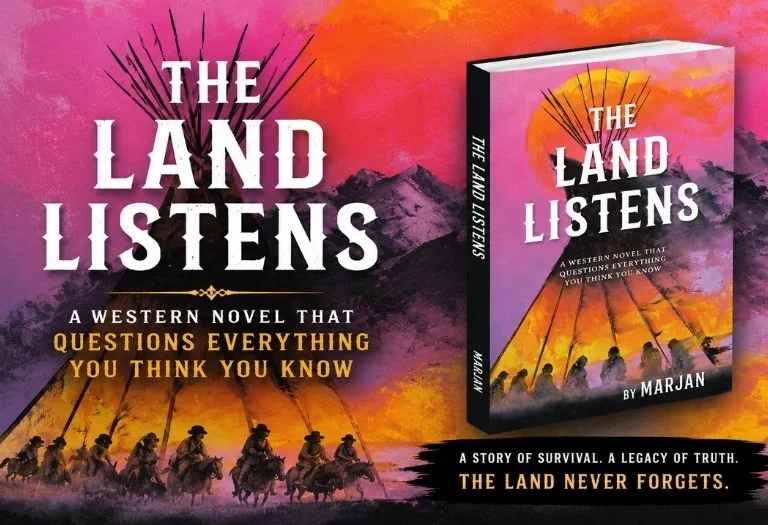

Some novels announce themselves. They arrive loudly, with high-concept premises and page-turning urgency. And then there are novels like The Land Listens by Marjan, a book that enters quietly, takes hold slowly, and stays with you far longer than you expect. This is deep literary fiction that earns its weight not through spectacle, but through precision. Every scene, every silence, every refusal is deliberate. And by the time you finish it, you realize the novel has quietly rearranged something in you.
Set in 1860s Montana, The Land Listens follows Elias Hawke, a surveyor trained to measure and master the world. When he enters an untamed valley and meets Chief Stone Crow and his people, the certainties he has carried his whole life begin to crack. What follows is a story about the cost of conscience, the ethics of land and belonging, and a question that literary fiction rarely asks so directly: can love be defined not by what it gives, but by what it absolutely will not do?
What The Land Listens Is Really About
Before anything else, it helps to understand what kind of novel this is. The Land Listens is not historical fiction in the conventional sense. It does not use the past as a backdrop for adventure or romance. It uses history the way the best literary fiction does: as a mirror, held close enough to make the present uncomfortable.
The novel is set during a period of intense American expansion, when surveying crews were sent westward with maps and mandates, and when Native American land rights were being systematically erased under the language of progress. Marjan does not editorialize. He does not need to. The historical record speaks, and the novel simply refuses to look away.
At the heart of the story is a specific tension: Elias has been given a job. Build the road. Survey the land. Submit the report. But the land he is surveying belongs to people who have lived there for generations. And the road, once built, will divide something that was never meant to be divided.
Chapter 23, titled What Love Refuses to Do, is where this tension reaches its quiet, devastating climax. The message arrives: the road will not be built. And the response to that news tells you everything about the moral world Marjan has constructed. There is no triumph. No fist raised in the air. Only something closer to reverence. A recognition that the land will remain whole, and that this is the right thing. Not the comfortable thing. Not a convenient thing. The right thing.
For readers who want to experience the full emotional arc of this story in a different format, The Land Listens is also available as an audiobook on Audible, where the novel’s careful pacing and restrained tone translate powerfully to narration.
Elias Hawke: A Hero Defined by Refusal
Literary fiction has given us many unforgettable protagonists, but few are as quietly radical as Elias Hawke. He is not a warrior or a revolutionary. He does not deliver speeches or lead movements. What makes him remarkable is simpler and rarer: he changes.
Over the course of The Land Listens, Elias moves through a transformation that mirrors the novel’s central argument. He begins the story as a man of action and order, shaped by his profession, his era, and assumptions about what the world is and how it works. He ends it as something far more complex: a man who understands that the most meaningful thing he can do is choose not to participate in harm.
From Actor to Witness
This shift is gradual. Marjan is far too good a writer to make it easy. Elias does not simply wake up one morning with a changed conscience. He is worn down by proximity to reality. By spending time with people whose lives his work is about to disrupt. By listening, literally and figuratively, to what the land and its people are saying.
By the end of the novel, Elias has moved from speaking to listening. From acting to understanding. From trying to change outcomes to recognizing which outcomes he simply cannot be part of. That arc places him in a very specific tradition of character-driven fiction: characters defined not by heroics, but by moral refusal.
He joins a lineage of literary figures who matter most because of what they refuse to become.
The Role of Silence in The Land Listens
One of the most striking aspects of Marjan’s craft is his use of silence. In a lesser novel, silence is absence. Here, it is architecture.
Stone Crow does not narrate history in clean, digestible terms. Margaret does not offer a complete account of her suffering or seek the reader’s sympathy. The past is present throughout the novel, but it is not excavated for the reader’s comfort. It exists, as it does in reality, in fragments. In implication. In what is deliberately left unsaid.
This approach asks the reader for something real. It asks you to sit with uncertainty. To accept that not every truth can be arranged neatly or spoken completely. And it treats the reader as capable of doing that, which is itself a kind of respect.
Margaret: Survival Without Resolution
Margaret’s story is perhaps the purest expression of this philosophy. She is not restored at the end of the novel. She is not given answers or the closure that so many narratives train us to expect. What she becomes, instead, is something far more honest: a person who has learned to exist without requiring the world to make sense of itself for her.
There is no dramatic declaration in her transformation. No cathartic scene is constructed to reassure the reader that everything, in the end, means something. Only a quiet steadiness. Hard-earned, unadorned, and deeply human.
In the context of trauma and survival in literary fiction, Margaret is an exceptional creation. She does not perform her grief. She carries it. And she continues.
Native American Land Rights and the Ethics of Progress
The Land Listens engages seriously and carefully with one of American history’s most contested and consequential themes: the relationship between indigenous peoples and the land that was taken from them in the name of expansion and progress.
Marjan does not reduce this history to a simple moral parable. He renders it as it was: complicated, bureaucratic, and full of people on all sides who were products of their time, whether they questioned it or not.
The road that appears in Chapter 23 is not just a road. It is a symbol of every infrastructure project, every surveying mission, every government mandate that framed indigenous displacement as neutral progress. The fact that the road is ultimately stopped is significant. But what is more significant is how that outcome is received. Not as victory over an enemy, but as the bare minimum of justice. Something that should have been obvious from the beginning.
For readers who want to understand the broader historical context of indigenous land displacement in 19th-century America, the Smithsonian National Museum of the American Indian offers extensive resources on the period Marjan’s novel inhabits.
The novel also resonates with contemporary conversations about environmental ethics and land sovereignty, themes that have only grown more urgent since the era it depicts. For further reading on environmental ethics and indigenous philosophy, the work of Robin Wall Kimmerer, including Braiding Sweetgrass, offers a rich companion perspective.
Love, Truth, and the Moral Vision of the Novel
The central argument of The Land Listens is not sentimental. It does not ask you to feel good about love. It asks you to take love seriously.
In Chapter 23, the novel arrives at its thesis: love is not measured by acts of generosity or sacrifice. It is measured, most precisely, by restraint. By the refusal to dominate. By the choice not to erase or justify harm for the sake of convenience or so-called progress.
This is a demanding definition. It does not let anyone off the hook. It cannot be satisfied by gestures or good intentions. It requires an actual refusal, in the moment when refusal costs something real.
Love That Does Not Offer False Peace
One of the things that distinguishes this novel from more commercially oriented literary fiction is its refusal to soften reality. Love, in Marjan’s world, does not tidy grief. It does not make it easier to carry. It does not excuse harm in the name of reconciliation. And it does not trade honesty for a peace that can only survive if no one speaks the truth out loud.
What emerges is a form of love that feels almost unfamiliar in contemporary fiction: disciplined, restrained, morally anchored. It draws a line. And it does not cross it, even when crossing would make everything simpler for everyone involved.
This moral clarity is rare. And it is what makes The Land Listens endure beyond its immediate story.
Why The Land Listens Belongs in Conversations About Meaningful Fiction
There is a category of novels that earns its place in a reader’s permanent collection. Not because it is enjoyable (though The Land Listens can be, in the way that honesty is enjoyable when you are tired of being managed). But because it changes how you see things.
This book belongs in that category.
It is historical fiction that takes its history seriously. It is philosophical fiction that does not mistake complexity for obscurity. It is a novel about grief and resilience that refuses cheap comfort. It is a story about indigenous perspectives and Native American land rights that does not reduce its characters to symbols of those themes.
And it is a book about love that is brave enough to define love by what it will not do.
To hear Marjan speak about the themes and writing process behind The Land Listens, visit the Marjan Books YouTube channel for interviews and author discussions that add depth to the reading experience.
For a broader conversation about how contemporary literary fiction is engaging with justice, identity, and historical accountability, Literary Hub’s ongoing coverage of historical and indigenous fiction provides excellent critical context.
Frequently Asked Questions About The Land Listens
What is The Land Listens by Marjan about?
The Land Listens is a literary historical novel set in 1860s Montana, following Elias Hawke, a government surveyor whose assignment brings him into direct contact with a Native American tribe whose land is threatened by a planned road. The novel explores themes of moral conscience, indigenous land rights, love, grief, and the meaning of refusing to participate in harm. Chapter 23, titled What Love Refuses to Do, is considered the emotional and thematic centerpiece of the book.
Is The Land Listens a good book for people who enjoy deep literary fiction?
Yes, strongly. If you value character-driven fiction, philosophical depth, and prose that earns its silences, The Land Listens will likely stay with you. It is not a fast-paced novel. Readers who enjoy authors like Marilynne Robinson, Barbara Kingsolver, or Louise Erdrich in terms of moral seriousness and literary restraint will find Marjan’s work rewarding.
Does The Land Listens accurately address Native American history?
The novel treats its historical context with care and seriousness. It is set during a period of American westward expansion when indigenous land rights were being systematically violated, and Marjan does not sanitize that reality. The book does not position its Native American characters as plot devices or symbols but as people with full interior lives and legitimate claims to their land and culture.
Is The Land Listens available as an audiobook?
Yes. The Land Listens audiobook is available on Audible, and the format suits the novel’s measured pace and quiet power exceptionally well.
What themes does The Land Listens explore?
The novel explores a wide range of interlocking themes, including Native American land rights, cultural displacement, environmental ethics, grief and resilience, the nature of love, moral courage, historical injustice, silence in storytelling, trauma and survival, and the difference between progress and harm. It is a book that earns every one of those themes rather than simply invoking them.
Who is the author, Marjan?
Marjan is the author of The Land Listens, a literary historical novel that has drawn attention for its restrained prose, moral depth, and serious engagement with indigenous history. Marjan’s books and author updates can be followed via the Marjan Books YouTube channel, and additional coverage of The Land Listens has appeared in the CB Herald.
Final Thoughts: A Novel That Earns Its Silences
The Land Listens does not announce itself. It does not need to. It settles into you. It asks you to listen the way its title suggests: not passively, but with full attention. And what it says, once you are truly listening, is something that very few novels have the discipline to say clearly.
Love is not what it does. Love is what it refuses to do.
That refusal is quiet. It does not raise its voice. But it is unyielding. And in its quiet, unyielding nature, The Land Listens earns its place among the novels that matter. Not because it offers comfort, but because it offers something more lasting: the truth, left intact.
If you are looking for thought-provoking novels that take history, justice, and moral courage seriously, this book belongs on your shelf. And if you want to experience it with a narrator who understands its rhythm, the audiobook version on Audible is an excellent place to begin.
Further reading and coverage of The Land Listens:
Marjan Has Released The Land Listens (CB Herald)