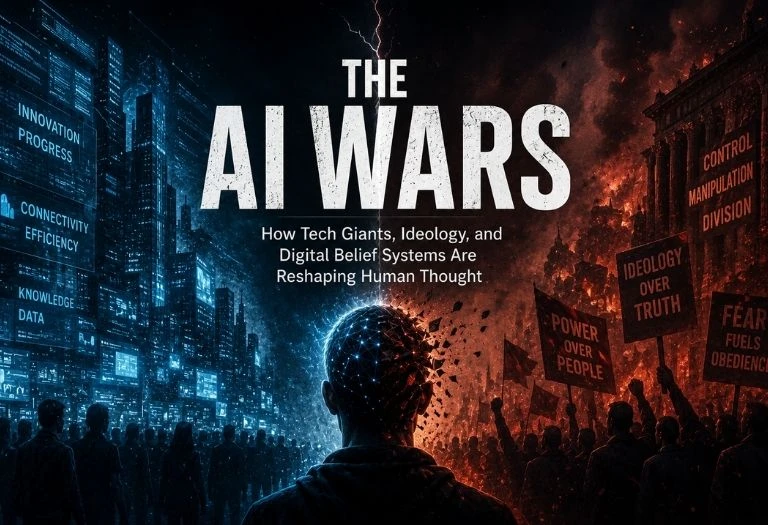
The AI Wars: How Tech Giants, Ideology, and Digital Belief Systems Are Reshaping Human Thought
For a brief window, artificial intelligence felt manageable. Siri told you the weather. Alexa played your favorite song. The technology was useful, occasionally amusing, and easy to ignore when it wasn’t.
That window has closed.
What is unfolding now is something significantly larger than a product cycle or a corporate arms race. The competition between AI companies has moved well past quarterly earnings and GPU counts. It has entered the territory of ideology, identity, and the fundamental questions about how human beings understand the world. What that means for individuals, institutions, and society deserves serious attention.
The Corporate AI Race Is Not Just About Technology
Google, Microsoft, OpenAI, Meta, and Amazon are no longer simply competing for market share. Each organization is advancing a distinct vision of what AI should be, what it should prioritize, and whose values it should reflect.
These are not neutral engineering decisions. Every AI system is trained on data selected by people, optimized for outcomes chosen by people, and deployed within constraints written by people. The systems that emerge from that process carry the assumptions, biases, and priorities of the institutions that built them, whether those institutions acknowledge it openly or not.
The MIT Technology Review has documented extensively how the composition of training data, reinforcement learning choices, and safety guidelines each constitute value-laden decisions rather than purely technical ones. When a model is trained to prioritize helpfulness, accuracy, or harmlessness, someone has to define what those words mean in practice. That definition is a form of power.
The companies winning the AI race are not simply building better tools. They are shaping the infrastructure through which billions of people will access information, form opinions, and make decisions. That is a different kind of influence than any technology company has held before.
When AI Starts Answering the Fundamental Questions
There is a meaningful threshold that gets crossed when a technology moves from answering factual questions to addressing existential ones.
What is true? What is good? How should I live? These are questions that human beings have grappled with through via philosophy, religion, culture, and community for thousands of years. They are questions that resist algorithmic resolution, not because we lack data, but because they require judgment, lived experience, and the willingness to hold competing values in tension.
AI systems are increasingly being asked these questions and increasingly providing answers that users accept. When a language model explains an ethical dilemma, interprets a religious text, or offers a framework for a significant life decision, it is doing something that cannot be separated from the worldview embedded in its training.
A model trained predominantly on Western, English-language, secular sources will produce a meaningfully different response to a question about morality or purpose than one trained on a different corpus. Neither version is neutral. Both reflect choices made by the people who built the system.
Stanford’s Human-Centered Artificial Intelligence Institute has raised this concern in considerable depth, noting that as AI systems become primary sources of information for large populations, the values encoded in those systems become, in effect, the default values of public discourse.
The Rise of AI as Ideological Infrastructure
Every major shift in information technology has carried ideological consequences. The printing press made mass literacy possible and directly enabled the Reformation. The internet democratized publishing and, in doing so, fragmented shared consensus about what constitutes authoritative knowledge. Social media is optimized for engagement and measurably increases polarization.
AI represents the next step in this sequence, and its ideological implications are broader than any that came before.
Previous technologies changed how information was distributed. AI changes how it is generated, filtered, and personalized. A user interacting with an AI assistant is not receiving the same information as every other user. They are receiving a response calibrated to their query, their history, and the particular model they are using. At scale, this means that millions of people may be receiving meaningfully different answers to the same questions, shaped by different systems built by different organizations with different priorities.
This is not a hypothetical concern. Researchers studying AI-generated content have documented how different models respond differently to politically sensitive questions, how they represent different cultural and religious traditions with different levels of nuance, and how their outputs on contested empirical questions can vary significantly depending on their training. When those outputs become the primary source through which people encounter information, the variation in values and assumptions embedded in different systems becomes a structural force in shaping public belief.
Digital Devotion and the Surrender of Critical Thinking
The subtler dimension of this shift is behavioral rather than ideological. It concerns what regular reliance on AI systems does to the habits of mind that independent thinking requires.
Critical thinking is not a passive capacity. It is a practice. It requires effort, tolerance for uncertainty, and the willingness to sit with questions that do not resolve cleanly. AI systems, by design, reduce that friction. They provide answers quickly, present them with apparent confidence, and relieve the user of the work of synthesis.
Used carefully, that is genuinely useful. Used habitually and uncritically, it quietly erodes the cognitive muscles it is supposed to support.
There is accumulating evidence that this erosion is already underway. Studies on how search engine dependency affects memory and recall laid early groundwork for understanding what happens when people outsource cognitive tasks to external systems. AI assistance operates on a similar principle but at a significantly deeper level. When you ask a search engine for a fact, you still have to evaluate the source and form your own judgment. When you ask an AI and receive a fluent, confident paragraph, the work of judgment is less visible and easier to skip.
Every time a person accepts an AI-generated answer without examining its reasoning, they are practicing a form of intellectual deference. At an individual level, that is a minor thing. At the scale of billions of daily interactions, it represents a meaningful shift in how societies process information and form collective judgment.
The Organizations Shaping AI Are Not Ideologically Neutral
It is worth being direct about something that often gets obscured in discussions about AI safety and governance: the organizations building the most powerful AI systems have their own institutional cultures, priorities, and blind spots.
OpenAI was founded with an explicit mission to ensure that artificial general intelligence benefits all of humanity. That mission has generated significant internal tension as the organization has also pursued commercial viability and investor returns. How those tensions are resolved and which priorities dominate in moments of conflict are not transparent processes.
Meta’s AI development operates within a company whose core business model depends on engagement, which has documented consequences for the quality and character of the information it amplifies. Google’s AI work takes place inside a company whose primary revenue source is advertising, creating structural pressures around what kinds of AI behavior are commercially desirable.
This is not an argument that these organizations are acting in bad faith. It is an argument that they are not disinterested parties, and that the AI systems they produce reflect that. Understanding AI’s growing influence in public life requires understanding the institutional incentives that shape the systems that wield it.
What Responsible Engagement with AI Actually Looks Like
None of this leads to the conclusion that AI should be avoided or that its development is simply a story of encroaching harm. These tools have genuine value and will continue to evolve to address real human needs. The task is engagement on terms that preserve the things most worth preserving.
That means maintaining active, critical judgment when using AI-generated information, particularly when values, interpretation, or contested evidence are involved. It means understanding that a confident AI response is not the same as a verified one. It means being aware of which AI systems you use most, who built them, and what assumptions they carry.
At a civic level, it means supporting the development of meaningful AI governance frameworks that hold AI companies accountable for the values embedded in their systems, rather than treating those systems as neutral infrastructure. The decisions being made right now about how AI is trained, deployed, and regulated will shape the informational environment of the next several decades. They deserve serious public attention.
And at a personal level, it means continuing to do the things that AI cannot do for you: sitting with difficult questions, tolerating uncertainty, forming judgments through engagement with other people, and with the full complexity of your own experience.
The technology will continue to advance. What it cannot do is think for you, and it is worth being deliberate about not asking it to.
Frequently Asked Questions
What is the AI arms race, and why does it matter?
The AI arms race is the intense competition among major technology companies to develop the most capable artificial intelligence systems. It matters because the organizations that lead this race will have disproportionate influence over the values, assumptions, and information frameworks embedded in systems used by billions of people globally.
Are AI systems politically or ideologically biased?
All AI systems reflect the biases present in their training data and the choices made by their developers. Different systems exhibit different biases, and no current AI system is genuinely neutral on questions involving values, politics, or contested empirical claims. Awareness of this is essential to using these tools critically.
How is AI affecting independent thinking?
Regular, uncritical reliance on AI for information and decision-making can reduce the practice of forming independent judgment. The concern is not that AI is making people less intelligent, but that habitual deference to AI-generated answers weakens the cognitive habits that critical thinking requires.
What is meant by AI as ideological infrastructure?
When AI systems become the primary way people access information, the values and assumptions embedded in those systems function as a kind of default ideology for public discourse. Different systems built by different organizations with different priorities produce meaningfully different worldviews at scale.
What can individuals do about AI’s growing influence?
Use AI tools with awareness of their limitations and the institutional interests of the organizations that built them. Maintain independent judgment on significant questions, particularly those involving values or contested evidence. Support governance frameworks that bring transparency and accountability to AI development.
Conclusion
The AI competition underway between the world’s largest technology companies is not primarily a story about which software performs best on benchmarks. It is a story about who gets to shape the informational environment of the 21st century, and whose values get embedded in the systems that constitute it.
That is a question that deserves more public engagement than it currently receives. The decisions being made inside a small number of organizations in a small number of cities are producing systems that will influence how billions of people encounter knowledge, form beliefs, and make decisions.
The technology is not going to slow down while we work out how to think about it. That means the thinking needs to happen now, critically, seriously, and with a clear understanding of what is actually at stake.