Publishing Scams: How Fraudsters Exploit Writers’ Hope for Profit
Writers carry a quiet fear. The fear that their work will never reach a reader, that years of effort will dissolve into silence. Publishing scams are built entirely around that fear. They do not target the careless or the naive. They target the hopeful, and hope is something almost every serious writer has in abundance.
Understanding how these schemes operate is no longer optional. As the tactics grow more sophisticated and the financial damage more severe, awareness has become one of the few reliable defenses a writer has.
This Is Not Scattered Fraud. It Is an Industry.
The publishing scam of twenty years ago was easy to spot. Poor grammar, implausible promises, obvious desperation. Today’s version is something else entirely.
Modern publishing scams operate as coordinated ecosystems. They are polished, patient, and often global. The people running them understand the publishing world well enough to sound credible. They know what writers want to hear, and they have built entire operations around delivering exactly that, at a price.
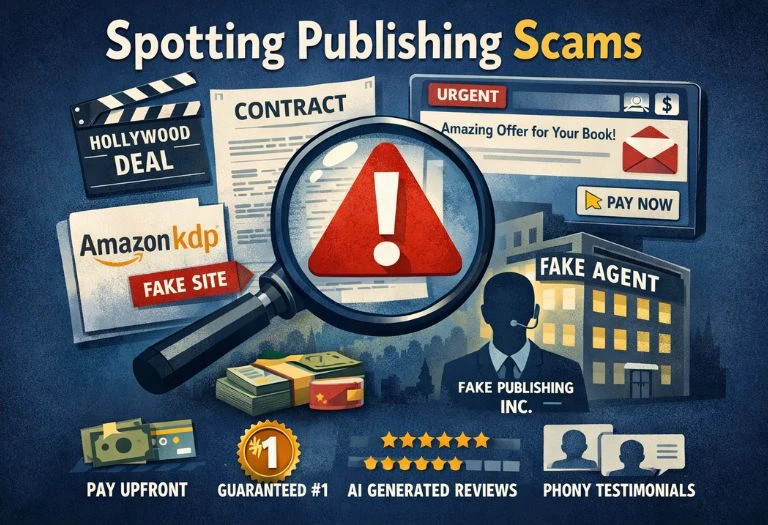
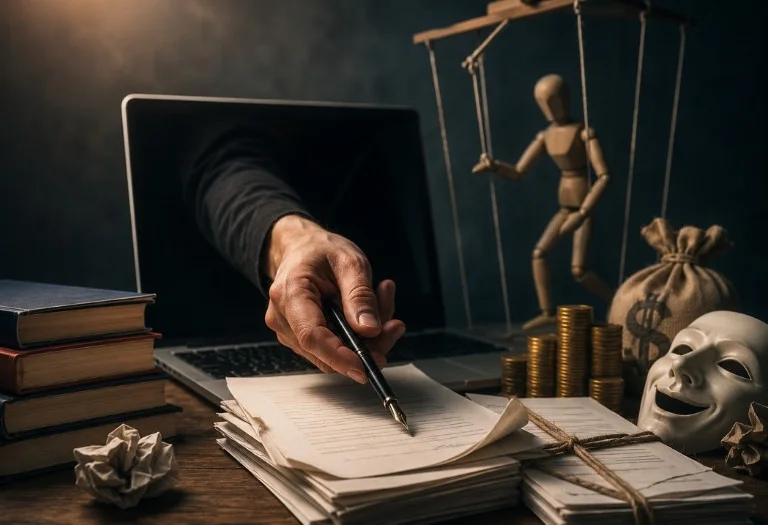
The masks vary. Publisher. Literary agent. Film producer. Publicist. Marketing consultant. The role shifts depending on what the target needs most, but the underlying script rarely changes. It opens with praise, introduces urgency, and quietly positions success as something just one payment away.
The actual business is not books. It is an extraction.
How the Initial Contact Works
Most writers who fall for these scams are contacted out of nowhere. An email arrives, a phone call comes in, or a message appears on social media. The tone is flattering, occasionally reverent, as though a hidden masterpiece has finally been discovered.
This is not recognition. It is bait.
The operation unfolds in stages. Enthusiasm is converted into invoices, one step at a time. What gets sold sounds just plausible enough to pass a quick inspection. Branding. Marketing campaigns. Film adaptation interest. Bookstore placement. Connections inside traditional publishing. It reads like an opportunity. In practice, it is theater, cheap services dressed in expensive language.
Press releases disappear into the void. Email blasts reach nobody. Book trailers accumulate no views. Reviews exist because the author paid for applause, not because readers actually responded. The product is the performance of progress, not progress itself.
The Escalating Trap
Once a writer engages, the structure becomes clearer, though rarely in the way the writer expects.
An agent offers representation, then fees appear for editing, legal review, or submission packages. A film producer expresses genuine interest, then requests a paid screenplay or pitch deck before moving forward. Each step feels like forward motion. The finish line keeps moving.
This is not a deal. It is a treadmill, and every mile costs money.
Some operations go further by impersonating established institutions. Real publishers. Real agencies. Real literary organizations. They use familiar names, cloned websites, and email domains designed to look almost correct. The difference might be a single transposed letter, a subtle misspelling, or an invisible domain extension swap. The illusion is deliberate. It is credibility borrowed without permission.
How Artificial Intelligence Made These Scams More Dangerous
The older version of the publishing scam was impersonal. A writer could feel the generic quality of the outreach and sense something was off.
That friction is largely gone now.
AI-generated messages are tailored, articulate, and often persuasive. They reference specific themes from a writer’s work, name characters, and acknowledge reviews. They feel like they came from someone who actually read the manuscript. That is precisely the point. The technology manufactures sincerity at scale. Flattery lands harder when it appears earned.
According to research on AI-generated content and deception, people consistently struggle to distinguish between human-written and AI-generated text, even when they believe they can. Scammers have already absorbed this finding into their operations.
The Psychology Behind Why Writers Are Targeted
The machinery matters, but it is not what makes these scams effective. The psychology is what makes them effective.
Writing is solitary work. The rewards are uncertain and often arrive years late, if at all. Recognition is rare. When someone appears unexpectedly, offering validation, especially specific and enthusiastic validation, it hits a nerve that most professional interactions never reach. Scammers understand this better than most editors ever will.
They are not selling services. They are selling relief from doubt.
That is why the red flags are so easy to overlook in the moment. The emotional conditions are not good for sober evaluation. A writer who has spent three years on a manuscript and heard mostly silence does not easily dismiss the first voice that says the work is extraordinary.
The Red Flags That Consistently Appear
The warning signs are specific and remarkably consistent across different scams and different countries. Knowing them in advance is the only reliable way to catch them before money changes hands.
Unsolicited outreach is the first signal. Legitimate literary agents do not cold-contact writers with offers of representation. Real publishers do not discover manuscripts through phone calls or social media messages. If the initial contact arrived without any action on your part, that is worth noting immediately.
Upfront fees are the second and most definitive signal. Legitimate agents earn commission on deals they close. They do not charge reading, submission, or editing fees, or any other fees, upfront. Any request for payment before representation is secured is a clear indicator of a scam operation. Writer Beware, maintained by the Science Fiction and Fantasy Writers Association, documents hundreds of specific operations and is an essential resource for any writer evaluating an offer.
Other consistent warning signs include vague or unverifiable credentials, testimonials that cannot be independently confirmed, generic email domains, pressure to move communication away from the platform where contact was made, and promises that dissolve under basic questioning. Guarantees of bestseller status, media appearances, or major distribution deals, always attached to a payment requirement, follow a pattern that has appeared in scam operations for decades.
Urgency is a particularly reliable indicator. When a supposed opportunity comes with a deadline measured in hours or days, that pressure is manufactured. Legitimate publishing opportunities do not expire overnight. When urgency enters the conversation, it is worth slowing down rather than speeding up.
The Real Cost to Writers
The financial losses are significant and well-documented. Writers have lost thousands of dollars to individual scams, and some have been defrauded of far larger sums over extended periods.
But the financial damage is not the only cost.
Writers caught in these schemes lose time, often months or years of it, spent pursuing fabricated progress. They lose momentum at critical points in their careers. They lose trust in legitimate opportunities because the experience makes every positive signal feel suspicious. Some stop submitting work entirely.
The operations that do the most lasting damage are the ones that string writers along rather than taking money and disappearing. Steady updates, plausible delays, fabricated milestones, all designed to sustain belief while the billing continues. It is a slow erosion disguised as professional development.
Protecting Yourself Without Becoming Paralyzed
The defense is straightforward, though it requires discipline at moments when excitement makes discipline difficult.
Verify everything independently. Check email domains character by character. Search company names alongside the word “scam” before responding to any outreach. Cross-reference with Writer Beware and Predators and Editors, two long-standing watchdog resources with extensive databases of problematic operations. When an organization is referenced, contact them through their official website using information you find yourself, not information provided in the message you are evaluating.
Understand the legitimate publishing pathway well enough to recognize deviations from it. Publishers Marketplace tracks real agent deal histories. QueryTracker documents agent responses and patterns. Familiarity with how professional publishing actually operates makes professionalism much easier to spot.
Never pay upfront for representation. That standard alone eliminates the majority of scam exposure.
Frequently Asked Questions
How do I know if a literary agent contacting me is legitimate?
Legitimate agents do not charge fees before securing a deal. They earn a standard commission, typically 15 percent for domestic deals and 20 percent for foreign rights, paid only after a publisher buys the work. Any agent requesting payment before that point is operating outside professional norms. Cross-referencing the agent’s name and agency through Publishers Marketplace or QueryTracker will show deal history and community feedback.
What is a vanity press, and how is it different from a legitimate publisher?
A vanity press charges authors to publish their work. A legitimate traditional publisher pays the author an advance against royalties and absorbs the production costs. Some hybrid publishers occupy the middle ground with legitimate services, but any arrangement in which the author pays high upfront costs warrants careful research before signing.
Are all self-publishing services scams?
No. Established self-publishing platforms like Amazon KDP and IngramSpark offer legitimate services at transparent pricing with no misrepresentation about what the author receives. Scam operations typically oversell results, guarantee outcomes no service can actually deliver, and charge fees that bear no relationship to the value provided.
What should I do if I have already paid for a scam operation?
Stop all further payments immediately. Document every communication and transaction. Report the operation to Writer Beware, your national consumer protection agency, and if credit card payments were involved, contact your card issuer to file a dispute. Sharing your experience publicly, through writing communities or review platforms, helps protect other writers from the same operation.
How do AI-generated scam messages differ from genuine outreach?
The difference is increasingly difficult to detect solely on writing quality. The more reliable approach is to evaluate the structure of the offer rather than the tone of the message. Unsolicited contact, upfront fees, unverifiable credentials, and urgency remain the consistent markers regardless of how well the message is written.
Conclusion
Writers are not being defrauded because they are careless. They are being defrauded because they care deeply about their work, about being read, about mattering in some way that extends beyond the private act of writing.
Scammers do not create that longing. They simply recognize it and step into the opening it creates.
The solution is not to become cynical about every positive signal or to stop submitting work. It is to build the habit of verification into the process before emotional investment takes over. Praise is not proof. A professional appearance is not legitimacy. A convincing voice is no longer evidence of a real person behind it.
In the current publishing landscape, hope backed by due diligence is a genuine asset. Hope without it is, as the pattern consistently shows, an invoice waiting to happen.