Publishing scams have not disappeared. They have evolved. In 2026, they are sharper, faster, and increasingly powered by AI tools that make fraudulent outreach look and feel alarmingly legitimate. Emails now quote your characters by name. Fake publishing companies have polished websites, fabricated staff profiles, and cloned branding from real industry names.
But here is what has not changed: every scam still ends with you paying.
This guide breaks down the most common publishing scams circulating in 2026, the exact warning signs to look for, and the principles that will protect you no matter how convincing the pitch sounds.
Why Publishing Scams Are Harder to Spot in 2026
The old scams were easy to identify. Poor grammar, vague praise, generic email addresses. Most writers could sense something was off within a few lines.
That era is over.
Today’s scams are AI-personalized. They reference your book’s plot, your characters, even your writing style. Some impersonate real agents and publishers convincingly enough to fool experienced authors. Others build entirely fabricated companies, complete with LinkedIn profiles, Google Maps addresses, and testimonials using stolen author photos.
The Alliance of Independent Authors and Writer Beware have both documented a sharp rise in sophisticated, AI-assisted fraud targeting authors at every stage of their publishing journey.
Understanding what you are up against is the first step. Knowing the patterns is the second.
7 Publishing Scams to Watch for in 2026
1. The “We Found Your Book” Cold Email
An agent or publisher reaches out unexpectedly, praising your manuscript with what sounds like genuine enthusiasm. They name your characters. They quote your opening chapter. They say your story is exactly what the market needs right now.
This feels extraordinary because it is designed to.
Legitimate publishers do not cold-email authors. Neither do reputable literary agents. The praise is generated from publicly available content, your book description, sample pages, or social media posts scraped and fed into an AI tool to produce a message that feels personal.
What to look for: no verifiable company history, a Gmail address or a domain with subtle misspellings, and language that creates urgency. Phrases like “we need to move quickly on this” are pressure tactics, not genuine enthusiasm.
2. The Pay-to-Publish Trap
You are asked to pay up front to be published. The business model here is straightforward: their revenue comes from you, not from selling your book.
In 2026, this was rebranded. You will encounter terms like “hybrid publisher,” “partnership publishing,” and “premium imprint.” Some of these models can be legitimate in narrow contexts, but the distinction matters: a genuine hybrid publisher is transparent about what authors pay, what they receive in return, and how royalties and distribution actually work.
Scam versions charge for vague “publishing packages,” push upsells after initial payment, and offer no credible path to bookshop shelves or meaningful distribution.
The Independent Book Publishers Association publishes criteria for ethical hybrid publishing that is worth reviewing before engaging with any paid publishing offer.
What to look for: fees described as investments, escalating packages, and distribution claims that cannot be independently verified.
3. Fake Amazon and KDP Impersonators
A company contacts you, presenting itself as affiliated with Amazon, Kindle Direct Publishing, or a related platform. The name may include “Amazon Publishing,” “KDP Partners,” or something similar that sounds official.
Amazon does not cold-contact authors to offer publishing services. KDP is a self-service platform with no fees. Any company claiming otherwise is misrepresenting itself and, in many cases, deliberately impersonating a trusted brand to exploit that trust.
What to look for: payment requests for services Amazon provides free, a website domain that is not amazon.com, and any outreach that originated with them rather than you.
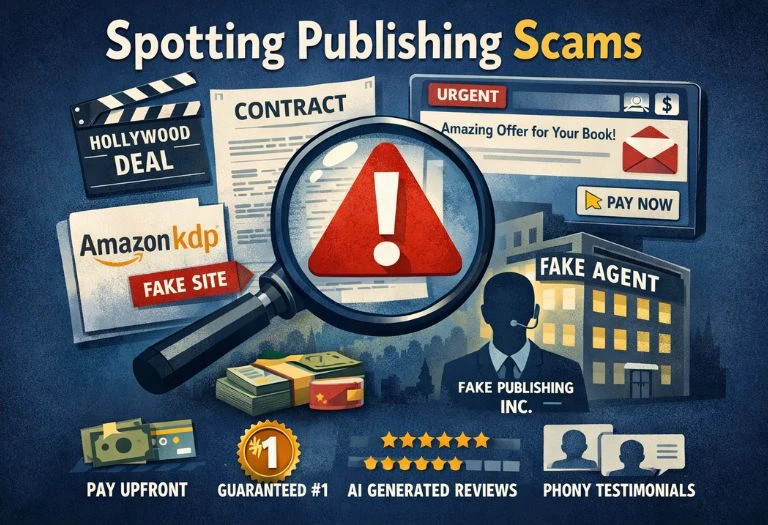
4. The Hollywood Adaptation Pitch
Someone reaches out claiming your book has attracted interest from a film producer, a streaming platform, or a Hollywood studio. The opportunity sounds extraordinary. All you need to do is fund the pitch deck, the treatment document, or the submission fee.
Real film and television deals do not work this way. Producers do not ask authors to fund their own pitches. Legitimate adaptation interest comes through literary agents and entertainment lawyers, not unsolicited emails with payment links.
Authors have lost significant sums chasing these offers. The Science Fiction and Fantasy Writers Association maintains resources on predatory film and media scams that are worth reviewing.
What to look for: named producers or studios that cannot be verified through independent searches, fees described as administrative or legal requirements, and deals that appear to hinge entirely on your payment.
5. Guaranteed Bestseller and Review Packages
No one in publishing can guarantee a bestseller ranking. Not a publicist, not a marketer, not a major house with a full campaign budget. The promise itself is the red flag.
In 2026, these scams have been upgraded with AI-generated review content, fabricated media placements, and fake influencer campaigns that produce surface-level metrics with no real reach. Authors pay for numbers that look impressive in a report but do nothing for actual readership or sales.
What to look for: “guaranteed #1” or “guaranteed review coverage” language, bulk review packages with no explanation of methodology, and an absence of transparency about how results are delivered.
6. Fake Companies With AI-Generated Staff
Some operations running publishing scams in 2026 have built convincing facades: polished websites, professional headshots, staff bios with credentials, even virtual office addresses. The problem is that none of it is real.
Staff photos are AI-generated or pulled from stock image libraries. Testimonials use real author names and images without permission. Office addresses resolve to mail forwarding services.
A reverse image search on staff photos using Google Images or TinEye will often reveal these within seconds. Searching staff names independently for any professional history is equally effective.
What to look for: staff with no verifiable LinkedIn presence, testimonials from authors who cannot be found elsewhere online, and office addresses that map to virtual office services.
7. The Endless Upsell Model
Some scams do not take everything at once. They take it gradually.
You pay for editing. Then marketing. Then a film pitch package. Then, global distribution. Each payment is framed as unlocking the next stage of your publishing journey. The promised breakthrough is always one more investment away.
Victims of this model frequently lose thousands over months before realizing the pattern. The escalation is deliberate, designed to exploit the sunk cost of what has already been paid.
What to look for: each contract or agreement framing your payment as a gateway to the next phase, no measurable results at any stage, and consistent pressure to continue investing.
The Core Rules Every Author Should Know
These principles apply regardless of how polished or persuasive an opportunity appears.
Money flows to the author, not from the author. In traditional publishing, you receive an advance and royalties. You do not pay to be published.
No legitimate opportunity requires urgency. Pressure to make quick decisions is a sales tactic. Real publishers and real agents allow time for due diligence.
Verify everything independently. Do not click links in their emails. Search the company names yourself, check them against Writer Beware, and look for third-party mentions outside their website.
Publishing moves slowly. Legitimate deals involve contracts, revisions, and long timelines. Any opportunity that promises fast results is selling you something that does not exist.
If it feels like a shortcut, treat it like a warning. The publishing industry rewards patience. Scams sell speed.
Frequently Asked Questions
How do I check if a publisher is legitimate?
Search the publisher’s name alongside terms like “scam,” “complaint,” or “review.” Cross-reference with databases like Writer Beware, the Alliance of Independent Authors’ watchdog list, and Predators and Editors. Look for a verifiable track record of books sold through major retailers.
Is hybrid publishing always a scam?
No. Some hybrid publishers operate with transparency and genuine distribution reach. The key is scrutinizing exactly what you pay for, what you receive, and whether the royalty structure is fair. The Independent Book Publishers Association’s hybrid publishing criteria are a useful benchmark.
What should I do if I have already paid a scam publisher?
Stop further payments immediately. Document all communication and payment records. Report the company to your national consumer protection authority and file a complaint with Writer Beware. If significant funds are involved, consult a legal professional.
Can AI-generated emails really be that convincing?
Yes. Modern AI tools can scrape publicly available content from your book listings, author website, or social media and generate outreach that references specific details from your work. Specificity alone is no longer a reliable indicator of legitimacy.
Do real literary agents ever reach out to authors first?
Occasionally, but rarely, and almost always after seeing your work through a query, a conference, or a recommendation. Unsolicited outreach from an agent you have never queried, particularly one who contacted you through a generic email address, should be treated with caution and independently verified.
Final Thoughts
Publishing scams do not succeed because authors are careless. They succeed because authors are hopeful, and that hope is precisely what gets exploited. The moment a pitch promises instant discovery, guaranteed exposure, or industry access in exchange for money, the pitch has stopped being an opportunity.
It has become a transaction where you are the product.
Protect your work, your time, and your money by knowing the patterns. The fingerprints are still there. You just have to know where to look.