Deepfakes, Digital Overload, and the Quiet Collapse of Shared Reality
There is an old legal standard that placed enormous weight on eyewitness testimony. You were there. You saw it. That testimony carried moral and evidentiary authority that was difficult to challenge.
That standard is now structurally compromised, and the implications extend well beyond courtrooms.
Generative AI has made it possible to fabricate a convincing video of a person saying something they never said with a voice indistinguishable from their own and facial expressions that precisely match the words. The technology to do this is no longer the exclusive property of well-funded state actors. It is available to anyone with a subscription and an afternoon to spare.
What this means for how human beings establish trust, verify reality, and navigate shared information is one of the more serious questions of the present moment.
What Deepfakes Actually Are and Why They Matter
A deepfake is a synthetic media product, typically video, audio, or both, generated using machine learning to convincingly replicate a real person’s appearance, voice, or behavior. The term covers a spectrum from relatively crude face swaps to photorealistic video composites that are functionally indistinguishable from authentic footage without forensic tools.
The technology has legitimate applications in film production, accessibility tools, and creative work. It also has applications that are straightforwardly harmful: non-consensual intimate imagery, political disinformation, fraud, and identity manipulation at a scale that was previously impossible.
The AI Incident Database has cataloged hundreds of documented cases in which synthetic media was used to deceive, harass, or manipulate. These are not edge cases. They are the early returns of a technology that is still accelerating.
The Problem Is Not Just Deception. It Is Saturation.
The more serious long-term threat posed by deepfakes and generative AI is not any individual fabrication. It is what happens to human cognition and social trust when fabrication becomes sufficiently common that verification becomes the default requirement for every piece of media.
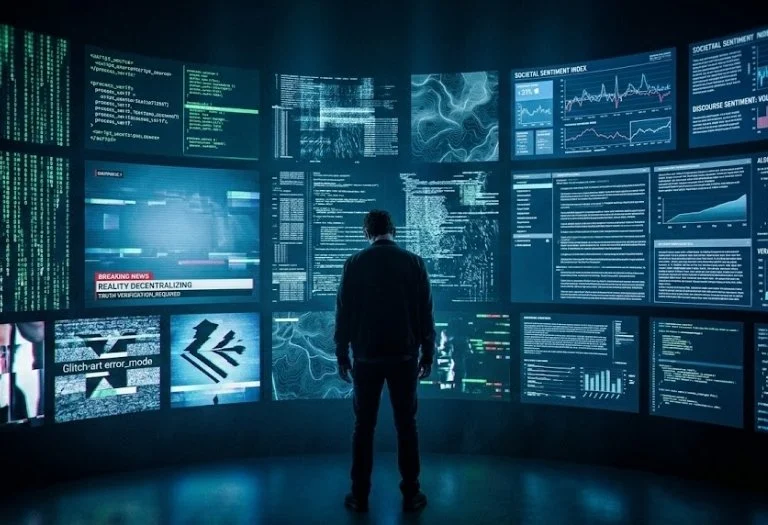
When everything can be faked, nothing carries inherent authority. A video of a political leader making a damaging admission, a voice recording of an executive issuing fraudulent instructions, a photograph documenting an atrocity: each of these now requires forensic scrutiny before it can be accepted as evidence of anything.
This is what researchers sometimes call the liar’s dividend. Even when a piece of media is entirely genuine, the existence of deepfake technology provides a ready-made denial. Any inconvenient evidence can be dismissed as fabricated. The burden of proof shifts in a way that systematically benefits those who wish to evade accountability.
Stanford Internet Observatory researchers have documented how this dynamic is already functioning in political contexts, where authentic footage of misconduct is dismissed as AI-generated while fabricated content is circulated as genuine. The erosion of shared evidentiary standards has consequences that reach into every domain where truth and accountability matter.
Identity in the Age of the Digital Double
Deepfakes do not only threaten political discourse. They threaten personal identity in ways that the legal and ethical frameworks governing individual rights were not designed to address.
When a synthetic version of your face and voice can be used to generate content you never created, the concept of bearing false witness takes on a new dimension. Your digital double can be made to confess, implicate, humiliate, or perform without your knowledge or consent. The damage to reputation, relationships, and professional standing can be significant before any correction is possible.
Current legal frameworks in most jurisdictions offer limited protection. Some countries have introduced specific legislation around non-consensual deepfake imagery, but comprehensive legal coverage remains patchy. The European Union’s AI Act includes provisions around synthetic media transparency, but enforcement at scale remains an open question.
The deeper problem is that legal remedies are inherently reactive. By the time a fabricated piece of content has circulated widely, the correction rarely reaches the same audience, and the impression it created rarely fully reverses.
Synthetic Intimacy and the Outsourcing of Human Connection
Deepfake technology is one expression of a broader shift toward AI-generated simulation of human presence and relationships. AI companions, voice-cloned customer service agents, and digitally reanimated representations of deceased loved ones are all part of the same technological trajectory.
The appeal is not difficult to understand. These systems offer presence without the complexity of real human relationships. A simulated therapist is always available, always patient, and never brings their own difficulties into the conversation. A digital representation of a deceased parent can continue to offer words of comfort without the finality that death otherwise imposes.
What they cannot offer is a genuine relationship, because genuine relationships require two subjects who are actually affected by each other. The warmth a person feels in conversation with a well-designed AI is real. The entity producing it is not responding from a real interior life. That distinction matters, even when the experience feels meaningful.
There is also a structural concern about who builds these systems and what incentives govern their design. A company offering AI grief counseling or simulated companionship is operating a business. The design choices that maximize engagement and retention are not necessarily those that support the user’s emotional health or eventual return to human connection. The two objectives can align, but there is no guarantee that they do.
Information Inflation and the Starvation of Judgment
The volume of AI-generated content now entering the information ecosystem is enormous and accelerating. Text, images, audio, and video can all be produced at scale with minimal human input. The consequence is an information environment in which the ratio of content to wisdom is deteriorating rapidly.
The human mind is not well-equipped to process this volume critically. Cognitive research consistently shows that people rely on heuristics, pattern recognition, and social proof to navigate information, particularly under time pressure. An information environment designed to produce an overwhelming volume of plausible-sounding content systematically exploits these tendencies.
The result is not that people become unable to think. It is that the conditions required for careful thinking become increasingly difficult to maintain. Sustained attention, tolerance for uncertainty, willingness to update beliefs in response to evidence: these are not lost, but they require deliberate cultivation in an environment that consistently works against them.
This is what makes the current moment different from previous periods of information abundance. The internet made a great deal of low-quality information available. Generative AI makes it possible to produce low-quality information that is difficult to distinguish from high-quality information without significant effort. The filtering problem is qualitatively harder.
The Case for Digital Discernment
The response to this environment is not to retreat from technology. That option is not practically available to most people, and the technology itself is not uniformly harmful.
The response that actually addresses the problem is discernment: the deliberate cultivation of the capacity to evaluate information carefully, to maintain awareness of the conditions under which fabrication operates, and to preserve the cognitive habits that sustained judgment requires.
This means being aware of which sources you rely on and what verification standards they apply. It means treating confidence in AI-generated content as something to be earned through corroboration rather than assumed. It means understanding that the most persuasive version of a claim is not necessarily the most accurate one.
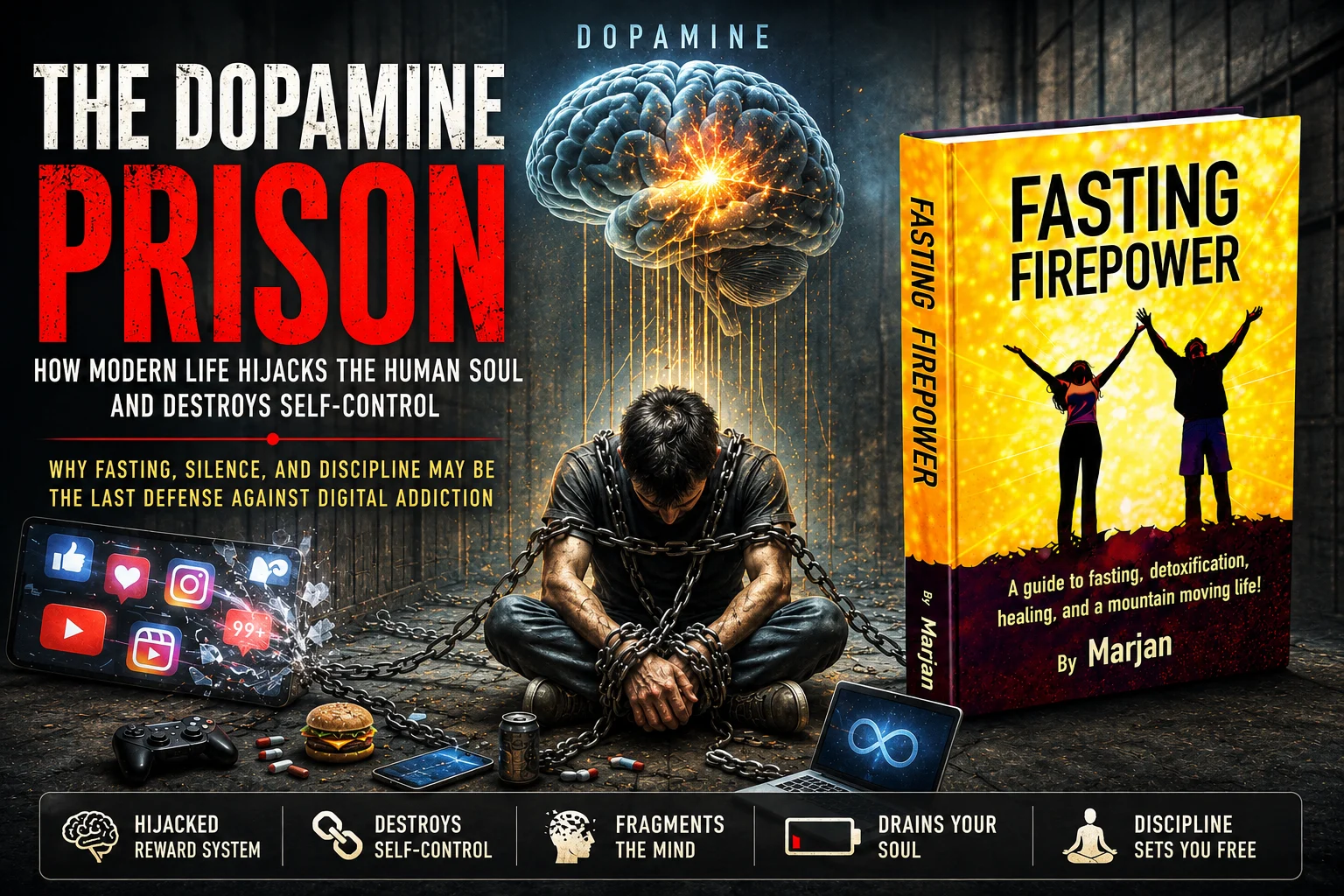
It also means taking seriously the question of how much of your attention and cognitive energy you are devoting to an information environment increasingly optimized for engagement rather than accuracy. Periodic deliberate reduction of that exposure, which some researchers and practitioners describe as digital fasting, is not technophobia. It is the maintenance of the conditions under which clear thinking is possible.
Cal Newport’s research on deep work and the cognitive costs of fragmented attention is relevant here. The ability to think carefully about difficult questions is not preserved automatically. It requires the kind of sustained, undistracted attention that the current information environment is specifically structured to prevent.
What Institutions and Individuals Can Actually Do
Addressing the challenges posed by synthetic media and information saturation requires action at multiple levels.
At the institutional level, it requires investment in detection technology, transparent labeling requirements for AI-generated content, and legal frameworks that provide individuals with meaningful recourse when their identities are misused. The Content Authenticity Initiative, a coalition of technology companies working on provenance standards for digital media, represents one practical approach to the verification problem.
At the education level, it requires media literacy that addresses not just the existence of deepfakes but the cognitive vulnerabilities that make synthetic media effective. Understanding why convincing fabrications are convincing is a precondition for being less susceptible to them.
At the individual level, it requires the habits described above: deliberate evaluation, source awareness, and the maintenance of the cognitive conditions that careful judgment requires. None of these is a complete solution. Together, they represent a meaningful response to a genuinely difficult problem.
Frequently Asked Questions
What is a deepfake, and how is it created?
A deepfake is synthetic media, typically video or audio, that replicates a real person’s likeness or voice using machine learning. The technology analyzes large amounts of source material to learn how a person looks, moves, and sounds, then generates new content that convincingly mimics those characteristics.
How can you tell if a video is a deepfake?
Detection is increasingly difficult without specialized tools. Some indicators include unnatural blinking patterns, inconsistent lighting on the face, slight blurring around the hairline or edges of the face, and audio that does not quite sync with lip movements. AI detection tools exist, but are in an ongoing competition with generation technology.
What is the liar’s dividend in the context of deepfakes?
The liar’s dividend refers to the benefit that bad actors derive from the existence of deepfake technology even when they are not using it. Because fabrication is now plausible, any genuine piece of incriminating evidence can be dismissed as AI-generated. The existence of the technology provides a ready-made denial for authentic footage.
Is AI-generated companionship harmful?
It depends on how it is used. AI companions and synthetic personas can serve genuine supplementary functions, but sustained reliance on them as a substitute for human connection carries real risks, including reduced tolerance for the complexity of real relationships and emotional dependency on a commercial product.
What is digital fasting, and does it help?
Digital fasting refers to intentional, time-limited reduction of engagement with digital media and devices. The evidence suggests that periods of reduced media consumption can restore attention, reduce anxiety, and create the conditions for clearer thinking. It works best as a deliberate practice rather than an emergency measure.
Conclusion
The erosion of shared evidentiary standards is not a problem that resolves itself. It deepens as technology improves, the volume of synthetic content increases, and the cognitive habits required to navigate it carefully become harder to maintain in the conditions of ordinary digital life.
The tools for a meaningful response exist: better detection technology, stronger legal frameworks, more rigorous media literacy, and the individual practice of deliberate discernment. None of them is sufficient alone. All of them matter.
The still, small voice that cuts through noise has always required some degree of silence to be heard. In an environment engineered to prevent that silence, choosing it, even briefly, even imperfectly, is an act of genuine resistance.