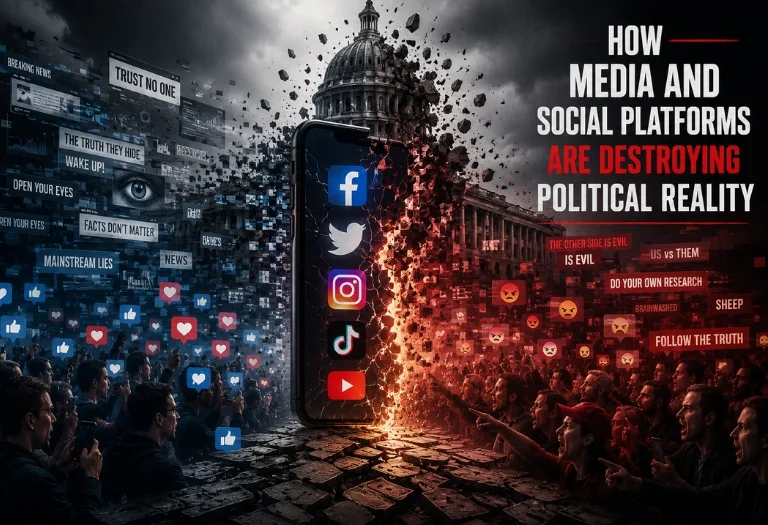
How Media and Social Platforms Are Destroying Political Reality
Every election cycle, something quietly breaks. Not a policy failure, not a single scandal, but something deeper. The shared reality that democracy depends on keeps fracturing, and most people scroll past the moment it happens without noticing.
The relationship between media, social platforms, and political life has fundamentally changed. What once looked like a communications revolution now functions more like a controlled demolition of public trust. Understanding how that happened and why it keeps accelerating matters far more than most political arguments currently do.
Before we explore the underlying forces behind this shift, it is essential to note: Outrage is not a bug in this environment. It is the business model.
Legacy media did not simply lose its way. It adapted to survive in a broken attention economy, and that adaptation came at a cost the public is still paying.
Journalism’s oldest function was to inform citizens so they could govern themselves. That function has not disappeared, but it has been buried under content designed to provoke rather than explain. When outrage drives clicks and clicks drive revenue, the incentive to inform shrinks while the incentive to inflame grows.
Research from MIT’s Media Lab found that false news spreads significantly faster than accurate information on social platforms. Not because people are foolish, but because emotionally charged content triggers faster sharing behavior. The system rewards heat over light, consistently and by design.
Cable news operates on the same logic. Partisan framing, selective omission, and manufactured urgency are not editorial failures. They are features. MSNBC and Fox News do not occupy opposite ends of the same journalistic spectrum. They function as emotional supply chains for two separate political tribes, each delivering the specific flavor of indignation their audience came to consume.
The Algorithm Is Not Neutral
Social media platforms present themselves as open forums. They are not. Every major platform, including Facebook, TikTok, YouTube, and Instagram, runs on recommendation engines trained to maximize engagement. Engagement data consistently rewards the extreme over the measured.
The result is what researchers call algorithmic radicalization: a slow drift toward more intense, more tribal, and more emotionally volatile content with each successive interaction. You do not choose that drift consciously. The platform engineers it for you.
What makes this particularly corrosive for political discourse is personalization at scale. A user in one city and a user in another, both following the same general news topics, may consume entirely different versions of the same event. Not because they sought out different sources, but because their feeds were algorithmically customized to match their engagement patterns. Over time, those two users are not just disagreeing politically. They are operating from incompatible factual foundations.
This is not a flaw in the system. It is the system working exactly as designed.
Microtargeting and the Architecture of Political Fear
Digital political advertising has transformed how campaigns manufacture consent. Traditional political ads reached broad audiences with broadly framed messages. Microtargeting replaced that approach with something far more precise. Thousands of individualized ad variants, each calibrated to a specific demographic’s fears, resentments, and tribal loyalties.
Facebook’s advertising infrastructure allows political operatives to target users based on psychological profiles assembled from behavioral data. One voter sees a message about economic anxiety. Another sees a message about cultural loss. A third sees threats to healthcare. The campaign’s actual positions may be identical, but the emotional packaging varies by audience. None of those audiences ever sees what the others are being shown.
This is not persuasion. It is precision-engineered manipulation that operates largely without public visibility or regulatory accountability.
Deepfake Democracy and the Collapse of Verifiable Reality
Generative AI has introduced a new category of threat to political information. Fabricated audio, synthetic video, and AI-generated images of public figures can now be produced quickly, distributed instantly, and consumed by millions before any verification process begins.
The Stanford Internet Observatory and similar research bodies have documented repeated instances of AI-generated disinformation circulating during recent electoral cycles. The problem is not only that fabricated content exists. It is that its existence poisons the well for authentic content. When any video or recording can plausibly be dismissed as synthetic, public trust in legitimate evidence erodes alongside trust in manufactured fakes.
This is the more serious damage. Not just that lies are spread, but that truth becomes harder to believe.
Foreign Interference and Domestic Amplification
State-sponsored disinformation operations are not a conspiracy theory. They are a documented feature of modern political warfare.
The Senate Intelligence Committee’s bipartisan report on Russian interference in U.S. elections detailed how coordinated troll farms exploited American social platforms to amplify division. They did not invent political conflicts. They poured accelerant on existing ones. The goal was never to install a particular candidate. It was to deepen distrust, inflame tensions, and weaken democratic institutions from within.
What makes this threat particularly difficult to counter is that domestic actors, including political operatives, media organizations, and individual influencers, often amplify foreign disinformation organically, without any coordination with its source. A fabricated narrative originating in a foreign troll farm can reach mainstream credibility within hours, simply by passing through enough emotionally receptive domestic channels.
Every repost is a distribution decision. Most people never think of it that way.
The Intellectual Vanity of Curated Certainty
One of the least discussed dimensions of political polarization is the role that educated confidence plays in sustaining it.
Higher education does not automatically produce skepticism of media narratives. In many cases, it produces the opposite. A fluency in ideological frameworks can make partisan news consumption feel like critical analysis. The person who can cite three academic sources for a position they arrived at emotionally is not engaging in rigorous thinking. They are rationalizing, with better footnotes.
This applies across the political spectrum. The machinery of polarization depends on people who are certain they have seen through the machinery, while remaining fully inside it.
Confirmation bias is not a working-class phenomenon. It scales with confidence and vocabulary.
Attention: Is the Resource Being Extracted
Strip away the political framing, and the media ecosystem operates on a simple extractive model. Human attention is harvested, packaged, and sold.
Your engagement with political content, your fear, your anger, your sense of tribal solidarity, generates revenue for platforms that have no stake in the actual outcomes of elections or governance. The rage produced while scrolling through a feed is not a side effect of the business model. It is the product being manufactured.
This framing matters because it changes how reform should be understood. Fact-checking initiatives, media literacy campaigns, and content moderation policies all assume that the problem is misinformation. The deeper problem is the incentive structure that makes misinformation profitable. Until the business model changes, the content it generates will keep evolving to circumvent whatever guardrails are introduced.
What Reclaiming Political Reality Actually Requires
None of this is hopeless, but the solutions that work are rarely the ones that feel satisfying.
Consuming information across ideological sources, not to find some artificial middle ground but to understand the full range of what is being claimed and why, builds a more accurate map of the information landscape. Organizations like AllSides provide media bias ratings and side-by-side coverage comparisons that make source diversity more practical.
Slowing down before sharing is not a passive act. It is a structural intervention. Algorithmic amplification of misinformation depends on rapid, low-friction redistribution. Every pause creates friction, and friction is one of the few tools ordinary users currently have at their disposal.
Supporting journalism funded by readers rather than advertisers removes at least one layer of the incentive problem. Publications operating on subscription or nonprofit models face different pressures than those dependent on engagement-driven ad revenue, and those pressures produce different editorial choices.
None of these steps reverse decades of structural decay in the information environment. But they are nothing.
Frequently Asked Questions
How do social media algorithms contribute to political polarization?
Recommendation algorithms are optimized for engagement, and emotionally charged partisan content consistently generates more engagement than nuanced reporting. Over time, this creates self-reinforcing filter bubbles where users are shown progressively more extreme content that confirms their existing beliefs. The polarization is not incidental. It is a direct output of the engagement-maximization model.
What is microtargeting in political advertising?
Microtargeting is the practice of delivering individualized political messages to narrowly defined audience segments based on behavioral and demographic data. Political campaigns use platform advertising tools to show different voters different messages, each calibrated to specific fears or values, without those voters ever seeing the full range of what the campaign is communicating to others.
Are deepfakes a significant threat to elections?
Yes, and the threat is evolving rapidly. AI-generated synthetic media can fabricate statements, appearances, and events involving real political figures with increasing realism. Beyond direct deception, deepfakes make it easier to dismiss authentic evidence as fabricated, which benefits anyone who has something to hide.
Can individuals meaningfully protect themselves from media manipulation?
Partially. Consuming news from sources with different editorial perspectives, slowing down before sharing, and understanding how platform algorithms work all reduce individual vulnerability. Individual behavior changes alone do not address the structural incentives that make manipulation profitable. Meaningful change at scale requires platform regulation and business model reform.
What role do foreign actors play in domestic political polarization?
Foreign state actors do not primarily invent political conflict. They identify and amplify existing divisions using social media infrastructure. Their goal is typically to degrade institutional trust and deepen social fracture rather than to elect specific candidates. Domestic actors who amplify this content, often unknowingly, extend its reach far beyond its origin.
The Cost of Staying Inside the Machine
Political reality is not simply discovered. It is constructed by the sources you trust, the platforms you use, the content you share, and the emotional states those choices reinforce over time.
The media and technology ecosystem currently in place was not built to serve democratic citizenship. It was built to serve engagement metrics. Those two things are not the same, and treating them as equivalent is one of the most consequential errors a citizen can make.
The question worth sitting with is not which side is right. It is who benefits from your certainty that you already know.