Why Most Book Marketing Fails (And What Actually Works)
Most authors who struggle with book marketing are not lazy. They are not untalented. They are not producing bad work.
They are aiming in the wrong direction.
That distinction matters because the solution to misdirected effort is not more effort. It is a clearer understanding of how readers actually find and choose books, and why most of what passes for book marketing today produces activity without results.
The Core Problem: Visibility Is Not the Same as Discovery
The advice authors receive most often is some version of the same instruction: be everywhere. Post consistently. Run ads. Send emails. Show up on every platform and stay visible.
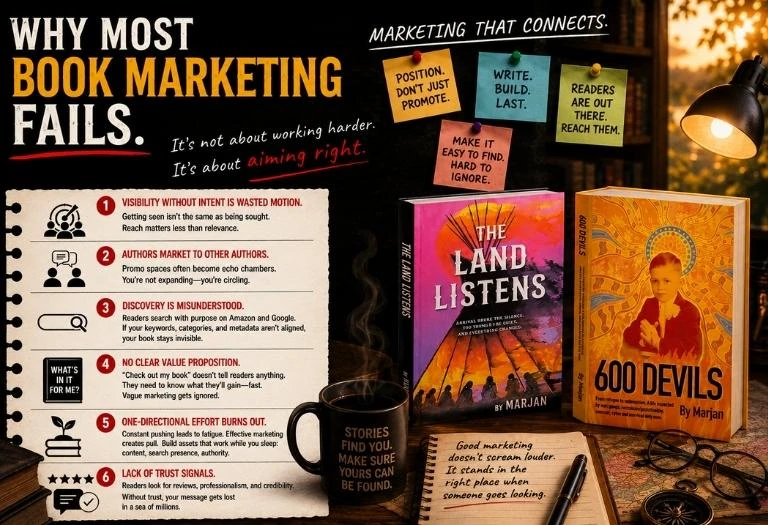
This advice is not entirely wrong. Visibility matters. But visibility without intent is wasted motion.
Being seen is not the same as being searched for. Someone scrolling past your book cover on a social media feed is having a fundamentally different experience from someone who typed a specific question into Google or Amazon and found your book as the answer. The first is passive exposure. The second is active discovery.
Real discovery happens when a reader with a specific interest, need, or question encounters your book as a relevant result. That is not luck. That is positioning. And positioning is something you can build deliberately.
Why Authors Keep Marketing to the Wrong Audience
One of the most common and least discussed traps in book marketing is the author echo chamber.
Most promotional spaces where authors are active, including writing groups, author-focused forums, social media communities built around the craft, and many book promotion services, are populated primarily by other writers. Writers are a specific kind of reader. They engage with books differently, buy for different reasons, and rarely represent the general reading audience.
If your marketing strategy lives entirely inside spaces where writers talk to other writers, you are circulating within a closed loop. Engagement may look healthy. Sales rarely follow.
The question worth asking is not where you can get the most likes or comments from people who understand the writing life. The question is where your actual reader, the person who would genuinely love this book and tell others about it, spends their time, and what they search for when they are looking for something new to read.
The Missing Value Proposition
There is a version of book marketing that consists almost entirely of announcing existence.
“My book is out.” “Check out my new release.” “Available now on Amazon.”
These announcements contain no reason to care. A reader encountering any of them for the first time has no basis for deciding whether this book is worth their time. They make that decision in seconds, and if the benefit is not immediately clear, they move on. There are millions of books available at any moment. Attention is genuinely scarce.
Strong book marketing communicates something specific. It answers the question the reader is silently asking: what will this do for me, or what will it make me feel? A clear, honest answer to that question is a value proposition. Without it, even well-designed promotions tends to produce indifference.
Push Marketing Burns Out. Pull Marketing Builds Assets.
Constant promotion is exhausting for the author and increasingly invisible to the audience.
There is a meaningful difference between push marketing, which involves regularly broadcasting your book’s existence to anyone within range, and pull marketing, which involves building assets that attract readers over time without requiring constant new effort.
Pull marketing for authors looks like content that answers real questions your target reader is asking. It looks like search-optimized metadata on retail platforms. It looks like a book description that works as a persuasive document rather than a plot summary. It looks like reviews, endorsements, and consistent presentation signal credibility before a reader has spent a single dollar.
These assets compound. A well-written book description keeps converting long after you wrote it. A blog post that ranks for a relevant search term keeps sending readers to your work while you sleep. A strong review record builds trust with every new visitor who finds your page.
Shouting louder is rarely the answer. Building better infrastructure almost always is.
Trust Signals Readers Actually Rely On
With millions of books competing for attention, readers have developed efficient filtering mechanisms. They rely on signals before they commit.
Reviews are the most obvious. A book with a credible review record, even a modest one, reads differently than a book with none. The number matters less than the presence and quality of genuine reader responses.
Presentation matters at the same level. A professionally designed cover, a well-structured retail page, and consistent author branding across platforms tell a reader, before they have read a single word of the actual book, that someone took this seriously. Inconsistency or amateurism in presentation raises doubt, and doubt rarely resolves in favor of a purchase.
Credibility signals also include media mentions, award recognition, and the quality of the author’s broader presence. None of these requires a large budget. They require intentionality and consistency over time.
The Alliance of Independent Authors maintains regularly updated resources on building author credibility and platform in ways that support long-term discoverability, and it is worth consulting for authors at any stage of their publishing journey.
What Effective Book Marketing Actually Looks Like
Effective book marketing is not louder. It is better positioned.
It starts with a clear understanding of who the ideal reader is and where they go when looking for something to read. It involves optimizing the book’s retail presence to perform well in search results on platforms like Amazon and Google, where active discovery happens at scale.
It means writing a book description that functions as a sales document, not a synopsis. It means collecting and presenting reviews in a way that builds trust. It means creating content, whether blog posts, videos, or other formats, that answers the questions your target reader is already asking and positions your book as the natural next step.
It means playing a longer game than most authors are willing to play, and understanding that the authors whose books sustain sales over months and years are almost never the ones who promoted the hardest at launch. They are the ones who built the right infrastructure and put their book in front of the right people.
For a practical framework on building that kind of lasting author platform, Jane Friedman’s publishing resource blog remains one of the most reliable and experience-backed references available to independent and traditionally published authors alike.
Frequently Asked Questions
Why do most book marketing strategies fail?
The most common reason is misdirection, not lack of effort. Authors invest time in high-visibility, low-intent activities, particularly promotion within author communities, rather than building the kind of search presence and credibility infrastructure that drives genuine reader discovery.
Is social media useful for book marketing?
It can be, but only when used to reach actual readers rather than other authors, and when it is part of a broader strategy that includes search optimization and trust-building. Social media alone, without supporting assets, rarely produces sustained sales.
What is the difference between visibility and discovery?
Visibility means someone encountered your book passively, typically through an ad or a social post. Discovery means someone actively searched for something and found your book as a relevant result. Discovery converts at a significantly higher rate because the reader arrives with existing intent.
How important are reviews for book sales?
Reviews are among the most important trust signals a book can have. They reduce the perceived risk of a purchase and provide social proof that the book delivers on its premise. Building a genuine review record, particularly in the early months after publication, should be a priority in any book marketing plan.
What should a book description include?
A strong book description functions as a persuasion document. It should identify who the book is for, what it delivers emotionally or practically, and why it is worth the reader’s time. It is not a plot summary. It is the answer to the question every potential reader is silently asking: why should I choose this one?
Final Thoughts
Most books do not fail because they lack quality. They fail because the right reader never finds them.
That is a solvable problem, but not by doing more of what is not working. Solving it requires understanding how readers actually discover books, building the assets that support that discovery, and having the patience to let those assets do their work over time.
Good marketing is not about being the loudest voice in a crowded room. It is about being the right answer when the right reader goes looking.
This post was written by Marjan, author of The Land Listens and 600 Devils. More of her work and editorial resources can be found at marjanbooks.com.