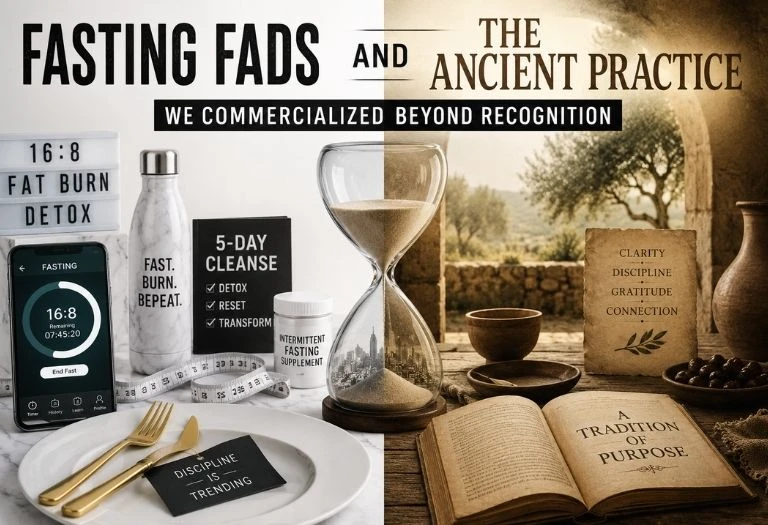
Fasting Fads and the Ancient Practice We Commercialized Beyond Recognition
Somewhere between Socrates sharpening his mind through deliberate hunger and a TikTok influencer selling a $29.95 monthly fasting tracker, something went profoundly wrong.
Fasting is one of the oldest intentional practices in human history. Philosophers, spiritual figures, and thinkers across every major civilization used it as a tool for mental clarity, self-mastery, and connection to something larger than appetite. Today, the same practice has been repackaged, trademarked, and monetized as a wellness category that would be unrecognizable to those who actually understood it.
This is not an attack on intermittent fasting or anyone trying to improve their health. It is an honest look at how a discipline with genuine depth became a vehicle for performance, profit, and absurdity, and what real fasting actually looked like before the biohackers arrived.
How Fasting Went From Discipline to Lifestyle Brand
For most of recorded history, fasting was not a trending topic. It was a demanding practice undertaken with specific intent, clarity of mind, mastery over physical impulse, spiritual preparation, or healing. The people who practiced it seriously were not chasing aesthetics. They were after something harder to quantify and considerably harder to fake.
The modern wellness industry discovered fasting and did what it does with everything it touches. It simplified the mechanics, removed the difficulty, added a subscription tier, and sold the results as inevitable.
Intermittent fasting arrived as the gateway. The concept is legitimate, restricting eating windows has documented metabolic effects, and the research published in the New England Journal of Medicine confirms real physiological benefits under the right conditions. But the gap between the clinical reality and the marketing language widened quickly. Abs became the primary selling point. Ancient wisdom became a branding strategy.
By the time intermittent fasting reached cultural saturation, the industry was already building the next product.
Sleep-Fasting and the Art of Effortless Transformation
The logical endpoint of wellness culture optimizing for minimal inconvenience arrived in the form of sleep fasting — the proposition that you can fast while unconscious.
The mechanics, such as they are, involve stopping food intake four hours before bed. You sleep. You wake up transformed, or at least statistically closer to ketosis than you were yesterday. The practice pairs naturally with a melatonin eye mask, bamboo bedding, and an app that auto-posts your overnight fasting data to your followers before you make coffee.
That last detail is not invented for effect. The commodification of health metrics into social content is a documented and growing phenomenon. Wearable devices and health apps increasingly feature sharing functions, because a fasting practice that no one knows about is apparently less effective than one that generates engagement.
The broader pattern is worth naming directly. Wellness culture has developed a reliable formula: identify an ancient or scientifically grounded practice, reduce it to its least demanding form, attach a proprietary product or subscription, and market it using the vocabulary of transformation. The customer gets the practices’ identity without most of its substance. The company gets recurring revenue.
H2: The Language of Invented Authority
One of the more interesting features of modern wellness marketing is its relationship with scientific-sounding language. Phrases like “mitochondrial wisdom,” “metabolic stillness,” and “quantum studies from Eastern European sleep clinics” circulate with apparent confidence because the audience rarely has the context to interrogate them and because the vocabulary of biology and physics carries persuasive weight even when applied to nothing real.
Health misinformation researchers at the Reuters Institute have documented how scientific-adjacent language significantly increases the believability of unverified health claims. The mechanism is simple. Most people cannot immediately evaluate a claim about mitochondrial function or quantum metabolism. The words sound credible. Credibility converts.
This is the intellectual environment in which Sleep-Fasting, Quantum Fasting, and other future branded practices will be sold. The product does not need to work in any verifiable sense. It needs to sound as though it should work, and it needs a community of users who experience enough placebo effect and confirmation bias to generate authentic-sounding testimonials.
What the Ancients Actually Did and Why It Worked
Socrates fasted. Plato fasted. The practice appears in Stoic philosophy, in every major world religion, in Hippocratic medicine, and in indigenous traditions across every inhabited continent. The consistency across cultures and centuries is not a coincidence. These were people working from direct observation of what fasting actually produced.
What they observed was not primarily physical. Mental clarity was the most consistently reported outcome, the sharpening of thought that comes after the body stops directing metabolic resources toward digestion. Contemporary neuroscience has begun documenting the mechanisms behind this, identifying autophagy, reduced neuroinflammation, and metabolic switching as physiological processes that correlate with the cognitive states ancient practitioners described intuitively.
The ancients also reported mastery over desire, the experience of sitting with hunger and choosing not to act on it as intrinsically valuable, independent of any physical outcome. This is categorically different from optimizing a fasting window for fat loss. It is the development of a psychological capacity: the ability to want something and consciously decline it.
Buddha did not sit under the Bodhi tree because he was tracking his macros. The Desert Fathers did not fast for 40 days to improve their insulin sensitivity. The goal was the transformation of character and consciousness, which required difficulty as a feature rather than a bug to be engineered away.
The Real Cost of Trivializing Fasting
The problem with fasting culture in its current form is not that people are trying intermittent fasting, tracking their eating windows, or experimenting with dietary restriction. All of those things can be useful when practiced with genuine intention and appropriate medical guidance.
The problem is the wholesale replacement of a demanding discipline with its most convenient imitation, dressed in the original’s language.
When the defining feature of a practice becomes its effortlessness, when you can fast in a parallel universe, or let a Bluetooth pill simulate the physiological state, or outsource the entire process to an app, the practice has been voided of the thing that made it effective. The difficulty was not an obstacle to fasting. It was the mechanism through which fasting worked.
Real fasting, practiced seriously and with intention, remains one of the more powerful tools available for mental clarity and physical health. The clinical research on fasting, including extended and time-restricted protocols, continues to yield significant findings. The ancient practitioners were not wrong. They were describing something real.
What they could not have anticipated was that their discipline would eventually be sold back to their descendants as a sleep accessory.
Frequently Asked Questions
Is intermittent fasting actually effective?
Yes, with qualification. Time-restricted eating has demonstrated real metabolic benefits in clinical research, including improved insulin sensitivity, reduced inflammation markers, and support for weight management. The effectiveness depends heavily on the consistency of practice, overall dietary quality, individual health status, and the specific protocol followed. It is not a universal solution, and the marketing claims significantly outpace the research in several areas.
What is the difference between modern fasting trends and traditional fasting practices?
Traditional fasting across most historical and spiritual contexts was primarily about mental and spiritual development, clarity of thought, mastery over physical impulse, and heightened awareness. The physical benefits were recognized but largely secondary. Modern fasting culture inverts this emphasis, centering physical transformation and using ancient language as marketing support rather than practical guidance.
Is sleep-fasting a legitimate health practice?
Stopping food intake several hours before bed has some supporting research related to circadian rhythm alignment and metabolic health. The theatrical packaging surrounding its apps, trackers, and branded protocols is a commercial product, not a scientific necessity. The underlying principle is reasonable. The branding is not what makes it work.
What does genuine fasting require?
Genuine fasting, as practiced across historical traditions and supported by contemporary research, requires sustained periods of caloric restriction undertaken with conscious intention, appropriate preparation, and adequate understanding of one’s own health conditions. The duration and method vary by tradition and purpose. What does not vary is the requirement for actual discomfort, the physiological and psychological experience of choosing not to eat when you could.
Can fasting improve mental clarity?
This is one of the better-documented claims in fasting research. Ketone production during fasting provides an alternative brain fuel source. Autophagy, the cellular cleaning process triggered by fasting, reduces neuroinflammatory markers. Studies on fasting and cognitive function consistently find self-reported improvements in focus and mental sharpness, particularly after the initial adaptation period. The ancients who described clarity as the primary benefit of fasting were observing something real.
Conclusion
The history of fasting is a history of serious people using a demanding practice to achieve difficult things. Clarity. Discipline. Healing. Spiritual depth.
That history has not been erased. It has been buried under a profitable layer of branded products, subscription apps, and wellness vocabulary that borrows the credibility of the original while removing most of its substance.
The practice itself remains available to anyone willing to engage honestly, which means engaging with the difficulty, rather than optimizing it away. The research supports it. The historical record supports it. The only thing that does not support it is the version being sold on most platforms today.
If the performative wellness cycle has left you with more products than results, the practice the ancient philosophers actually used is still there, unchanged, waiting for anyone willing to take it seriously.
For a grounded, experience-based guide that connects ancient fasting wisdom with modern science, visit Marjan Books.