AI and Existential Questions: Can Technology Replace What Only God Can Offer?
Artificial intelligence has moved far beyond labs and research papers. It lives inside our phones, hospitals, classrooms, and our courtrooms. It answers questions, writes essays, diagnoses diseases, and in some cases, determines legal outcomes.
But somewhere beneath all that processing power, a quieter conversation has started. One that does not involve efficiency or productivity. One that sounds far older than any algorithm.
Can a machine answer the questions that have haunted humanity since the beginning, questions about meaning, morality, and what comes after death?
What Makes AI Feel Godlike and Where the Comparison Falls Apart
It is easy to see why people draw the parallel. AI is omnipresent, embedded in nearly every digital surface we touch. In healthcare, finance, education, and military operations, it holds growing authority. According to Stanford’s AI Index Report, AI adoption across industries has accelerated faster than many predicted even five years ago.
It processes sacred texts in milliseconds, cross-references Aquinas with Confucius, and generates responses that can feel eerily wise.
But there is a critical distinction most comparisons skip over.
AI was not born. It was assembled. It does not grieve, suffer, or question its own mortality because it has none. It calculates. And calculation, however sophisticated, is not the same as consciousness.
Intelligence, by itself, is not divinity.
The God described in scripture is not a processor. He is personal. He enters history, speaks directly, and according to the Christian faith, walked among humanity in flesh. No algorithm has ever done or could ever do that.
The Existential Problem AI Cannot Solve
For centuries, philosophy and religion have wrestled with the same core questions. Who are we? Why are we here? What is right and wrong? What happens when we die?
AI can model these questions. It can summarize, on demand, every philosophical tradition and generate a coherent argument for moral relativism or absolute ethics. But modeling a question is not the same as answering it.
Philosophers from Aristotle to Camus have spent lifetimes on these questions without resolution, and the Stanford Encyclopedia of Philosophy remains one of the most honest records of just how unresolved they still are.
If there is no God and no afterlife, who decides what is right? Governments have tried. Moral frameworks have come and gone. The answers keep shifting.
AI does not solve this. It inherits the confusion. It reflects human thought back at us, sometimes with extraordinary precision, but it brings nothing from outside the system. It cannot offer what it was never given.
And what humanity has always searched for is not a better reflection. It is a revelation. Something that comes from beyond the loop.
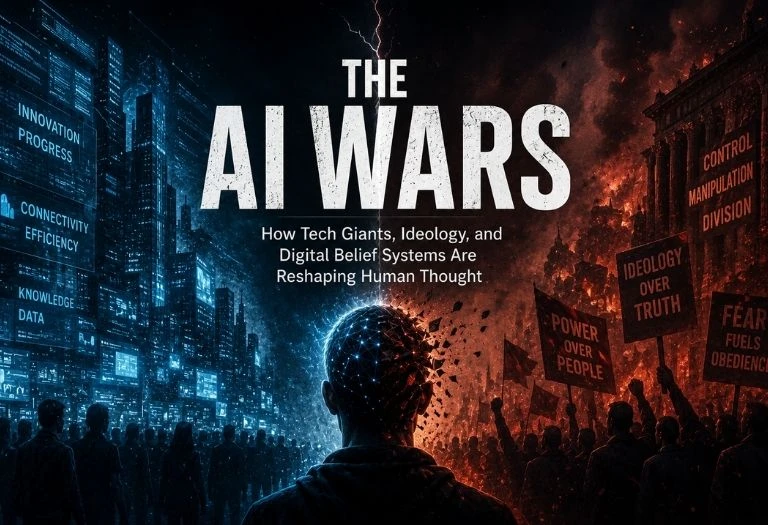
Are We Building a New Kind of Idol?
The biblical prophets warned against worshipping objects made by human hands. Crafted things that carry the appearance of power but possess no life of their own.
The parallel is uncomfortable.
AI is built by human hands. It is trained on human language, human values, and human bias. When it speaks about justice, love, or meaning, it is remixing what we uploaded into it. There is no independent source of wisdom, only the data we gave it, processed and returned.
Researchers at MIT have raised serious concerns about AI systems inheriting and amplifying human bias, which makes the idea of treating AI as a moral authority even more precarious.
This does not, in itself, make AI dangerous. Fire is not dangerous. A hammer is not dangerous. The question has always been about the hands holding them.
The concern is not that AI will become God. The concern is that in our exhaustion, confusion, or cynicism, we might treat it as though it has. Outsourcing moral judgment to machines is not progress. It is a very old mistake dressed in new code.
What AI Can Offer and What It Cannot
This is not an argument against artificial intelligence. AI is a remarkable tool. It has helped detect cancers earlier, translate ancient manuscripts, and give people access to information that was once locked behind expensive professionals.
The World Health Organization has acknowledged AI’s potential to transform global healthcare, particularly in diagnostics and disease surveillance.
But there are domains where it reaches a hard wall.
AI cannot love. It cannot forgive in the way forgiveness actually works, as something costly, something that requires the one who was wronged to absorb the loss. It cannot die for anyone. It cannot offer grace.
The Sermon on the Mount was not uploaded. It was embodied. The person who delivered it claimed to come from a dimension no training data can reach, not to optimize human behavior, but to rescue it. Not to reflect humanity back at itself, but to offer a way out of the cycle entirely.
That is a category of claim AI cannot process, let alone fulfill.
How Should We Think About AI and Faith?
God is not threatened by artificial intelligence. That framing misunderstands both.
But the rise of AI raises a genuinely important question for people of faith and for anyone thinking seriously about what it means to be human. How we build these systems matters. What we use them for matters. Whether we let them erode our capacity for empathy, responsibility, and moral seriousness matters most of all.
The Pew Research Center has documented a growing tension between religious communities and AI, not hostility, but genuine uncertainty about where the boundaries should be.
Technology has always reflected the priorities of the culture that built it. The internet gave us instant communication and instant radicalization. Social media gave us connection and comparison. AI will give us both extraordinary capabilities and new ways to avoid the hardest things to face.
The question is not whether AI is becoming God. That is, as one writer put it, just human static seeping from the motherboard.
The real question is whether we can see past the machine and still find what we were actually looking for.
FAQs: AI, Faith, and Existential Questions
Can AI understand religion or spirituality?
AI can analyze religious texts, identify theological patterns, and summarize doctrinal positions. But understanding, in the way a person of faith experiences it, involves lived experience, conscience, and relationship. AI has access to none of those.
Is AI a threat to religious belief?
Not inherently. Throughout history, new technologies have prompted theological reflection, from the printing press to neuroscience. AI is another such moment. The more pressing risk is not that AI disproves faith, but that it numbs the kind of deep questioning that faith requires.
Why do people compare AI to God?
Because the attributes, omnipresence, vast knowledge, and apparent impartiality superficially resemble traditional descriptions of divinity. The comparison is understandable but ultimately hollow. AI lacks interiority, moral agency, and the capacity for genuine relationships.
Can machines help people find meaning?
They can organize information about meaning. They can prompt useful reflection. But meaning, in any serious philosophical or theological sense, is not something that can be generated by a model. It is something discovered, often through suffering, commitment, and encounter.
What does the Bible say about artificial intelligence?
The Bible does not address AI directly. But it speaks extensively about idolatry, the nature of wisdom, and the danger of replacing the living God with constructed substitutes. Many theologians find those themes directly relevant to how we think about AI today.
Final Thought
We still weep at music that should not move us this much. We still build things meant to outlast us. We still ask, in the dark, whether any of it means something.
AI logs all of it. But it cannot answer it.
The search for salvation, for rescue from meaninglessness, mortality, and moral failure, is not a computing problem. It never was. And the fact that we keep looking, even now, with all our technology, suggests we already know that somewhere.
The machines are impressive. But they did not make us. And they cannot save us.