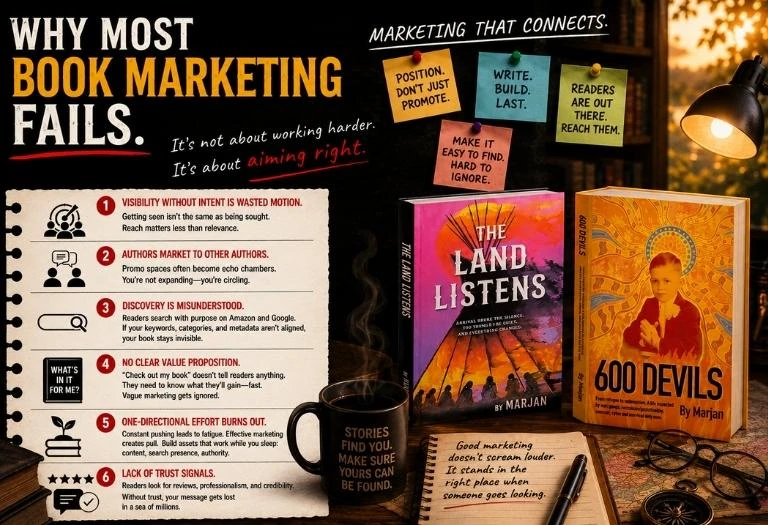
What Actually Sells Books Online? There is a version of book marketing that feels productive but is ineffective. Posting five times a day, running untargeted ads, chasing trending hashtags… none of it adds up to much if the foundation is wrong. For authors writing literary fiction, thought-provoking novels, and character-driven stories rooted in cultural displacement, grief, and resilience, the game is even more specific. This guide is about that specificity.
What follows is not a list of tactics. It is a way of thinking about discovery, trust, and the reader relationship… the three things that actually convert attention into sales.
Start With the Reader’s Search, Not Your Own Instincts
The single most overlooked variable in book marketing is search intent. A reader does not wake up thinking about your title. They wake up thinking about a feeling they want to have, a question they want answered, or a story world they want to enter. Your job is to be findable at that moment.
For literary fiction in particular, this means understanding how readers describe books they love before they have discovered yours. They search for phrases like “books that make you think,” “deep literary fiction,” “novels about truth and silence,” or “historical fiction set in early 1900s Indigenous communities.” If your title, subtitle, and book description speak that language, you become discoverable. If your copy uses only your own framing of the interior meaning you intended, you become invisible.
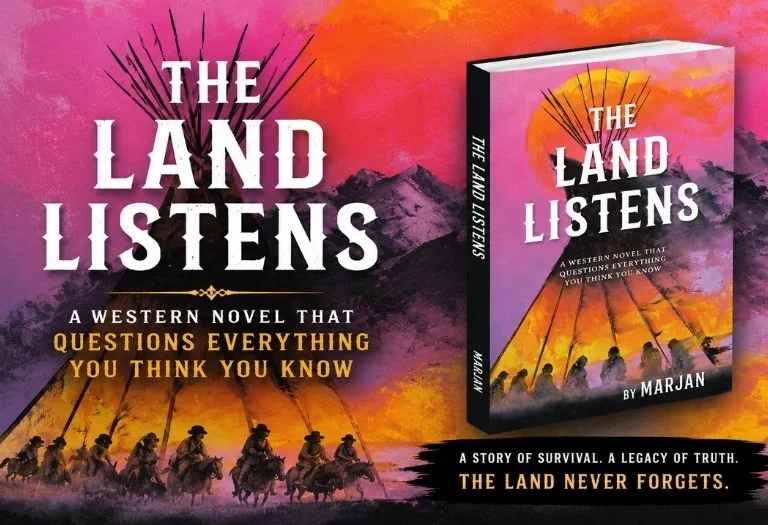
See this principle in action with The Land Listens
Marjan’s audiobook is now available on Audible, a format that dramatically expands discoverability. Listen to The Land Listens on Audible and explore how a story about land, identity, and moral courage finds its readers.
Own Your Audience Before You Need Them
Every author who depends entirely on a single platform, such as Amazon rankings, Instagram reach, and TikTok algorithms is building on borrowed ground. Algorithms change without warning. Platform reach collapses. And when that happens, so does visibility.
The authors who sustain consistent sales are the ones who have built a direct line to their readers. That means an email list, a newsletter with real personality, and a reader relationship that does not depend on any third party to deliver it.
This is especially true for authors writing literary fiction and philosophical fiction. Your readers are not impulse buyers. They are deliberate. They think carefully about what they read next. An email that arrives in their inbox at the right moment, with the right message converts better than any algorithm-driven impression.
Email is slow, and that is exactly why it works
There is a common misconception that email marketing is outdated. The opposite is true. Unlike social media, where your post competes with hundreds of other pieces of content in a single scroll, email reaches someone who has specifically chosen to hear from you. They are already a warm reader. The decision to open and read your message is already halfway to a purchase.
For authors of meaningful fiction novels about grief and resilience, Native American land rights, justice and accountability, the email relationship becomes a genuine correspondence between a writer and their most loyal readers. That is not marketing. That is community.
Social Proof Sells Books More Than Any Campaign
Readers do not want to be first. They want to join something that others have already validated. This is the uncomfortable truth about literary fiction marketing: a book with twenty authentic reviews will consistently outsell a better book with three.
Reviews on Amazon and Goodreads are not vanity metrics. They are conversion tools. A reader who is undecided looks at the review count before they read the first line of your description. The social signal matters more than the content.
The implication for authors is clear. Getting your first twenty to fifty genuine reviews is more valuable than any paid promotion you could run at the same stage. Advance review copies, direct outreach to book bloggers, submission to literary review sites these efforts compound in a way that ad spend does not.
“A great book that no one finds won’t sell. A decent book with strong positioning will. That gap is where most literary authors lose their audience.” — Marjan
Communities Trust Recommendations More Than Advertising
Books about cultural displacement, trauma and survival, and Indigenous perspectives are not discovered through banner ads. They are shared in communities where trust already exists. BookTok, Goodreads reading groups, niche literary newsletters, cultural advocacy networks, university syllabi, these are the ecosystems where readers of deep literary fiction actually live.
The value of appearing in even one well-trusted community is disproportionately high. A single recommendation inside a reading group for historical fiction or environmental ethics can deliver more readers than a month of social media posting. And unlike ads, those recommendations do not expire. They continue to circulate long after the conversation moves on.
For authors working in genres such as philosophical fiction, silence in literature, and thought-provoking novels, the strategy is not mass awareness. It is targeted belonging. Find the specific communities whose readers are already searching for the kind of questions your book asks, and show up there as a genuine participant rather than a promoter.
Video content creates the author connection that readers want
Literary fiction readers are not just buying a story. They are entering into a relationship with a mind. Author interviews, readings, and reflections on the themes of your work create the personal connection that turns a curious browser into a committed reader.
Marjan’s YouTube channel is a space where those conversations happen, exploring the themes of land, silence, truth, and identity that run through his work. Video is not about performance. It is about presence.
Format Determines Who Can Find You
The same book can reach dramatically different audiences depending on how it is presented and where it lives. Print, ebook, and audio are not interchangeable versions of one product. They serve different discovery contexts, different reading habits, and different moments in a reader’s day.
Audiobooks, in particular, represent a significant opportunity for literary fiction. Readers who commute, exercise, or listen while they do other things represent a large audience that simply cannot reach your book in print form. A literary novel about truth in storytelling, love and loss, and the long memory of land the kind of story that benefits from voice and pacing, can reach an entirely new readership through audio.
Distribution breadth also matters. Being present on Audible, in libraries through services like Libby, on ebook platforms, and in physical independent bookstores is not redundancy. It is coverage. Each channel has readers who rarely venture into other channels.
The Land Listens: Now in Audio
Marjan’s novel about Native American land rights, moral courage, and the silence that carries history is available as an audiobook. Press coverage from CB Herald and EIN Presswire highlights how the story found its audience across multiple platforms.
What Specifically Works for Literary and Historical Fiction
Genre fiction has many playbooks. Literary fiction, and particularly historical fiction set in early 1900s contexts with Indigenous perspectives and environmental ethics, requires a more targeted approach. Here is what actually moves the needle for this category.
Lead with themes, not plot summary
Readers of deep literary fiction make decisions based on what a book is about at the thematic level, not what happens in it. “A novel about grief and resilience in early twentieth-century rural America, told through the relationship between a family and the land that remembers” reaches a specific reader much more effectively than a plot-driven summary.
Build credibility through editorial coverage
Literary fiction readers trust editorial sources: book review publications, literary journals, and cultural commentary platforms. A well-placed review in the right venue carries more weight than dozens of social media posts. Targeting your press outreach toward publications that cover meaningful fiction, cultural displacement, and moral courage aligns you with the readers who are most ready to connect with your work.
Connect with book clubs directly
Book clubs are the single most underutilized channel for literary fiction. A novel that generates genuine discussion about justice and accountability, about the ethics of land and identity, and about what truth costs, is exactly what book clubs look for. Reaching out directly to book clubs, offering discussion guides, and making yourself available for virtual author conversations creates a sustained sales channel that runs long after launch.
Think about your reader’s next book
The readers most likely to recommend your novel are the ones who loved it enough to search for what to read next. Curating your own reading recommendations builds the kind of author authority that keeps readers returning to your corner of the literary world and makes your next book easier to sell.
Frequently Asked Questions
How do I sell literary fiction online when it is harder to market than genre fiction?
Literary fiction benefits most from targeted community engagement rather than broad advertising. Focus on Goodreads groups, literary newsletters, book clubs, and podcast outreach to hosts who cover meaningful fiction. The audience is smaller but far more committed. One passionate reader recommends your book to ten others.
Do book reviews really matter for online sales?
Yes, significantly. Reviews on Amazon and Goodreads act as social proof that converts undecided readers. For literary fiction, especially, even 20 to 30 genuine reviews can dramatically improve conversion rates. Prioritize getting early readers to leave honest, thoughtful reviews over any paid promotional tactic at launch.
Is an audiobook worth it for literary fiction?
Audiobooks expand your audience to readers who may never pick up a physical book but listen regularly. For literary and historical fiction, audio also adds a layer of emotional experience that suits the genre well. Platforms like Audible represent a separate discovery channel with its own search and recommendation system.
What social media platform works best for literary fiction authors?
Goodreads remains the most important platform for discovery in literary fiction specifically. Beyond that, YouTube for longer author conversations and Instagram for visual storytelling around themes and settings tend to perform better than TikTok for this genre. The most effective approach is a consistent presence in one or two channels rather than scattered activity across many.
How long does it take for book marketing to show results?
For literary fiction, the marketing timeline is longer than for genre fiction. Reviews, community relationships, and editorial coverage compound over months rather than weeks. Building an email list and cultivating genuine reader relationships means that each new book you publish launches to an existing audience, and that is where long-term results come from.
What keywords help literary fiction get found online?
Search-driven discovery for literary fiction works best with theme-based and emotion-based keywords: books that make you think, character-driven fiction, thought-provoking novels, deep literary fiction, philosophical fiction, grief and resilience, and specific historical or cultural contexts relevant to your story. These are the phrases readers actually search for when they are looking for their next meaningful read.
“The readers who need your book are already searching for it. The only question is whether they can find you.”
The Honest Summary
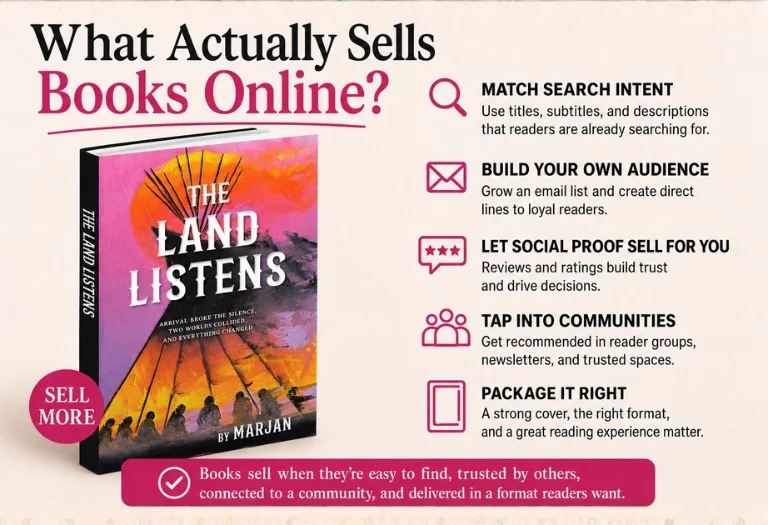
Books sell when they are easy to find, trusted by others, connected to a community, and delivered in a format readers want. For literary fiction for novels about land and identity, truth and silence, love and moral courage, none of this happens overnight. But the authors who understand these fundamentals build readerships that last beyond any single launch.
The goal is not to be everywhere. The goal is to be exactly where your reader is looking, at the moment they are ready. Everything else is noise.
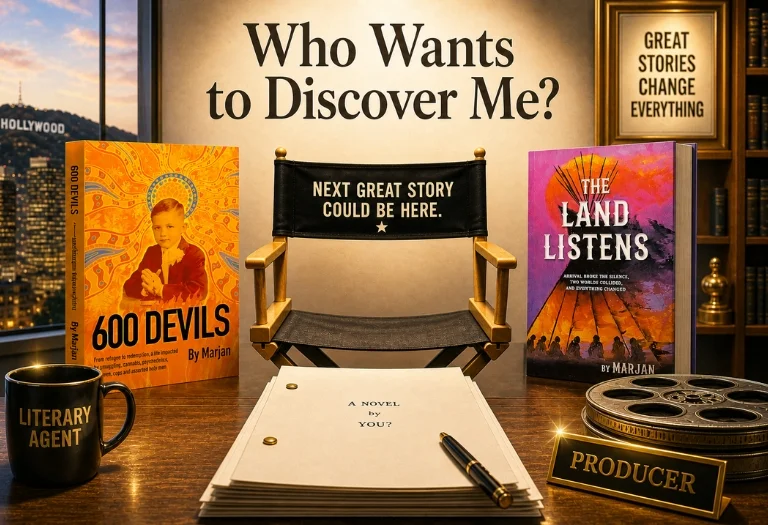
Marjan is the author of The Land Listens, a work of literary fiction exploring Native American land rights, environmental ethics, and the long memory of truth. Follow her work and conversations on YouTube.