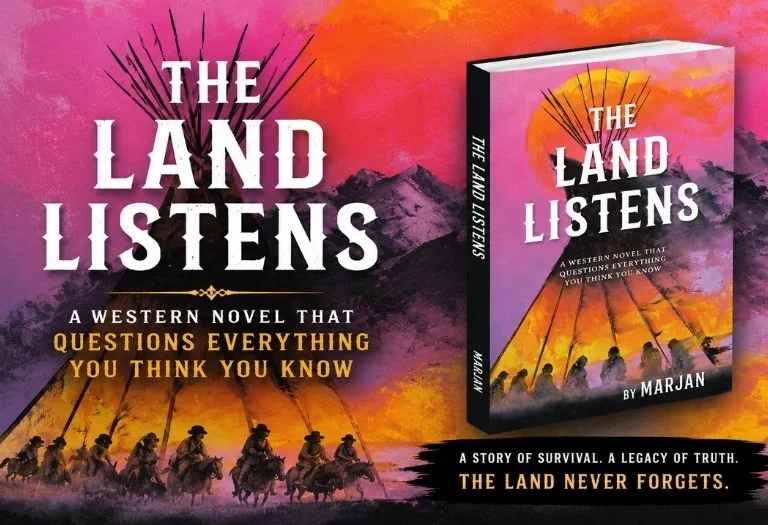

There is a particular kind of novel that does not try to convince you of anything. It does not argue. It does not moralize. It simply places you inside a world rendered so carefully, so honestly, that by the time you reach the final page, something in you has shifted.
The Land Listens by Marjan is that kind of novel.
Set in the Montana Territory of the 1860s, this work of deep literary fiction follows Elias Hawke, a government surveyor sent to map untamed land into neat, ownable parcels. What he encounters instead is a reckoning with everything his profession, his era, and his civilization have taught him to take for granted. When he meets Chief Stone Crow and his people, Elias does not find resistance in the dramatic sense. He finds a different grammar for existence altogether, and it unmakes him quietly, line by line.
This review explores why The Land Listens stands apart from other historical fiction novels set in the American West, and why readers drawn to thought-provoking novels about land, identity, indigenous perspectives, and moral courage will find it deeply rewarding.
What Kind of Novel Is This?
Before anything else, it helps to know what The Land Listens is not.
It is not a frontier adventure. It is not a noble savages narrative. It is not a white savior story dressed in period costume. Marjan is careful, even fastidious, in avoiding these traps. The result is something rarer: a philosophical fiction that takes the form of a historical novel while refusing the comforts the genre typically provides.
At its core, this is a book about epistemology. About how we know what we know. About the stories civilizations tell themselves to justify expansion, erasure, and control. Elias arrives in the valley with surveying instruments and instructions. What he does not arrive with is any framework for understanding that the land he is measuring is already fully inhabited, already fully meaningful, already complete.
Readers who enjoy character-driven fiction, literary fiction that lingers, or novels exploring environmental ethics will recognize the territory immediately. But The Land Listens pushes further than most.
The Central Tension: Two Ways of Belonging
The novel’s most durable achievement is the relationship it builds between Elias and Chief Stone Crow, which is not a friendship exactly, nor an antagonism, but something harder to name: a sustained encounter between two incompatible frameworks for the world.
Elias measures. He draws lines, drives stakes, converts wilderness into coordinates. This is not villainy. It is a worldview. He believes, genuinely, that precision is truth, that land becomes productive only once it is categorized and claimed.
Chief Stone Crow does not measure. He belongs. His people do not live on the land the way settlers do. They live within it, as participants rather than owners. The valley is not a resource to be allocated. It is a relationship to be honored.
Marjan never editorializes. He does not tip the scales by making Elias cartoonishly blind or Stone Crow implausibly wise. Both men are rendered with full interiority. The tension between them is ideological, not moral, which makes it far more unsettling.
This is the heart of what makes The Land Listens a work of meaningful fiction: it refuses to resolve the conflict into a lesson. It simply holds the two worldviews in the same frame until the reader feels the weight of the distance between them.
The Mystery of Captain Bell
Running alongside Elias’s internal unraveling is the unexplained disappearance of Captain Bell, a soldier whose fate the novel deliberately refuses to resolve.
Accounts contradict one another. Evidence points nowhere conclusive. The official record is silent.
This narrative choice is not a flaw. It is a thesis.
The Land Listens is, in part, a novel about the limits of certainty, about how easily the historical record can be shaped by those with the power to shape it, and about how silence in literature can be more truthful than explanation. Bell’s disappearance mirrors Elias’s own internal fracture. One is a man vanishing. The other is a worldview collapsing under its own contradictions.
For readers interested in justice and accountability, or in novels about truth and its elusiveness, Bell’s subplot will land with particular weight. It asks: when the record says nothing, what does that silence protect? And who decides what gets recorded in the first place?
Indigenous Representation Done With Care
One of the most significant ways The Land Listens distinguishes itself from lesser works in this space is in how it handles its Indigenous characters.
Chief Stone Crow and his people are not instruments of Elias’s transformation. They are not there to instruct him, redeem him, or serve as the moral backdrop against which his growth is measured. They have their own interior lives, their own continuity, their own relationship with the land that precedes Elias’s arrival and will outlast whatever he decides to do.
This is, frankly, unusual. Too many novels dealing with cultural displacement and Native American land rights fall into the trap of centering the white protagonist’s awakening while Indigenous characters remain static and symbolic. Marjan avoids this by giving his Indigenous characters agency, interiority, and survival that do not depend on Elias’s recognition.
The novel quietly insists: they were here before him. They will endure after him. His understanding of them is not the measure of their existence.
For readers seeking indigenous perspectives rendered with honesty rather than sentimentality, this is essential reading.
If you prefer to experience the novel through audio, The Land Listens Audiobook on Audible offers an immersive way to absorb the novel’s careful pacing and spare, precise prose.
The Land as Character
Marjan’s Montana Territory is not a scenic backdrop. It is an active presence.
The valley neither argues nor explains. It does not take sides. It simply remains patient and indifferent to whatever human narratives are imposed upon it. Its seasons proceed. Its silences deepen. Its rhythms predate every instrument Elias carries.
This is where the novel enters the territory of environmental ethics and makes its most quietly radical argument: that the land itself has a kind of moral weight that exists independent of legal categories. Not in a mystical sense. In a practical, observable sense. The valley functions. It sustains. It holds memory in ways that no deed or map can replicate.
Elias gradually comes to understand, without epiphany, that what he is mapping is not simply geography. He is mapping a decision. Each stake he drives is not descriptive. It is prescriptive. It does not say what the land is. It says what the land will become.
The distinction is everything.
What The Land Listens Is Really About
Strip away the historical setting, the surveying plot, the mystery subplot, and the novel’s question becomes legible in its simplest form:
What does it mean to belong to a place, not as an owner, but as a witness?
Elias has spent his professional life believing that belonging is established through documentation. Through maps, deeds, and surveys. Chief Stone Crow’s people have spent generations knowing that belonging is established through presence, through care, through memory, through the kind of attention that cannot be filed or recorded.
Grief and resilience live in this gap. So do trauma and survival, love and truth, and the kind of moral courage that does not look heroic from the outside. The choice Elias eventually faces is not dramatic. It is quiet, specific, and irrevocable.
He must decide whether to continue participating in something he no longer believes in.
No applause. No ceremony. Just a decision.
Comparisons and Context: Where This Novel Fits
Readers who have loved certain books will find familiar resonances here, though The Land Listens is its own distinct creation.
Those who appreciated the moral complexity of Paulette Jiles’ News of the World will recognize the spare prose and the ethical weight Marjan brings to the frontier. Readers drawn to the philosophical dimensions of Richard Powers’ The Overstory will find a kindred seriousness about land and time. Fans of Tommy Orange’s There There will appreciate Marjan’s refusal to reduce Indigenous experience to stereotype or symbol.
But The Land Listens is quieter than all of these. It moves slowly and deliberately, trusting its readers to sit with discomfort without being told how to feel.
This is historical fiction from the 1860s that reads more like philosophical fiction. It asks questions it refuses to answer, and that refusal is the point.
For Readers, Book Clubs, and Classrooms
The Land Listens is exceptionally well-suited for book club discussion because it generates genuine disagreement. Reasonable readers will differ on what Elias should have done, on whether Marjan is too hard on the settler worldview, and on what Bell’s disappearance actually means.
Those teaching courses on American history, environmental literature, or indigenous studies will find the novel useful precisely because it resists tidy lessons. It models the kind of thinking students need: sitting with ambiguity, questioning inherited frameworks, and recognizing how power shapes the historical record.
For readers who simply want a literary recommendation that will stay with them: this is it.
Watch Marjan discuss his work and creative process on the official Marjan Books YouTube channel, where he shares insights into the research, themes, and characters behind The Land Listens.
A Note on Marjan’s Craft
Marjan writes with restraint. His sentences earn their weight. There is no ornamentation for its own sake, no emotional manipulation through purple prose. The novel’s power accumulates through what is withheld as much as what is given.
This is the craft of a writer who trusts his material. Who knows that the valley does not need to be described as beautiful to be felt as sacred. Who knows that Elias does not need an epiphany speech for his transformation to be real?
The Land Listens has received attention from literary news outlets, including CB Herald and EIN Presswire for its distinctive voice and timely engagement with questions of land, sovereignty, and historical reckoning.
What Readers Want to Know About The Land Listens
Is The Land Listens based on real events?
The novel is set in a specific historical period, the Montana Territory of the 1860s, and engages with real historical dynamics, including government surveying, Indigenous displacement, and military presence in the West. The characters and specific events are fictional, but the framework they inhabit is historically grounded.
What genre is The Land Listens?
It is primarily historical fiction, but readers and critics have also placed it in the categories of literary fiction, philosophical fiction, and environmental literature. It resists clean genre classification, which is part of its appeal.
Is this novel suitable for high school or college courses?
Strongly yes. It handles complex themes around cultural displacement, Native American land rights, justice and accountability, and moral courage with nuance and without sensationalism. It would pair well with primary historical texts, indigenous scholarship, and other works of literary fiction engaging similar questions.
How does Marjan handle Indigenous representation?
With unusual care. The novel centers on an Indigenous community without reducing them to symbols, mentors, or victims. Their continuity, knowledge, and interiority are rendered as real and self-sufficient, independent of the protagonist’s understanding or approval.
Is The Land Listens slow-paced?
It is deliberately paced. Readers who prefer plot-driven fiction may find it contemplative. Readers drawn to character-driven fiction, philosophical fiction, or books that make you think will find the pacing exactly right.
What is the significance of Captain Bell’s disappearance?
Bell’s disappearance functions as the novel’s structural argument about the unreliability of the historical record. His fate is deliberately left unresolved to illustrate how easily truth can be lost, suppressed, or left unrecorded when power shapes documentation.
Where can I find The Land Listens audiobook?
The Land Listens audiobook is available on Audible, and is an excellent way to experience the novel’s spare, precise language in full.
Final Thoughts
The Land Listens will not give you the satisfaction of resolution. It will not tie its conflicts into a bow or confirm that the right people won. It will leave you with a question about belonging, about measurement, about what it means to witness something rather than possess it.
That is not a weakness. It is the novel’s greatest achievement.
In a literary landscape that often rewards speed and sensation, Marjan has written a book that asks for patience and rewards it. A book where the land itself is the most powerful character, not because it acts, but because it remains.
The land does not argue.
It listens.
And after reading this novel, you will too.