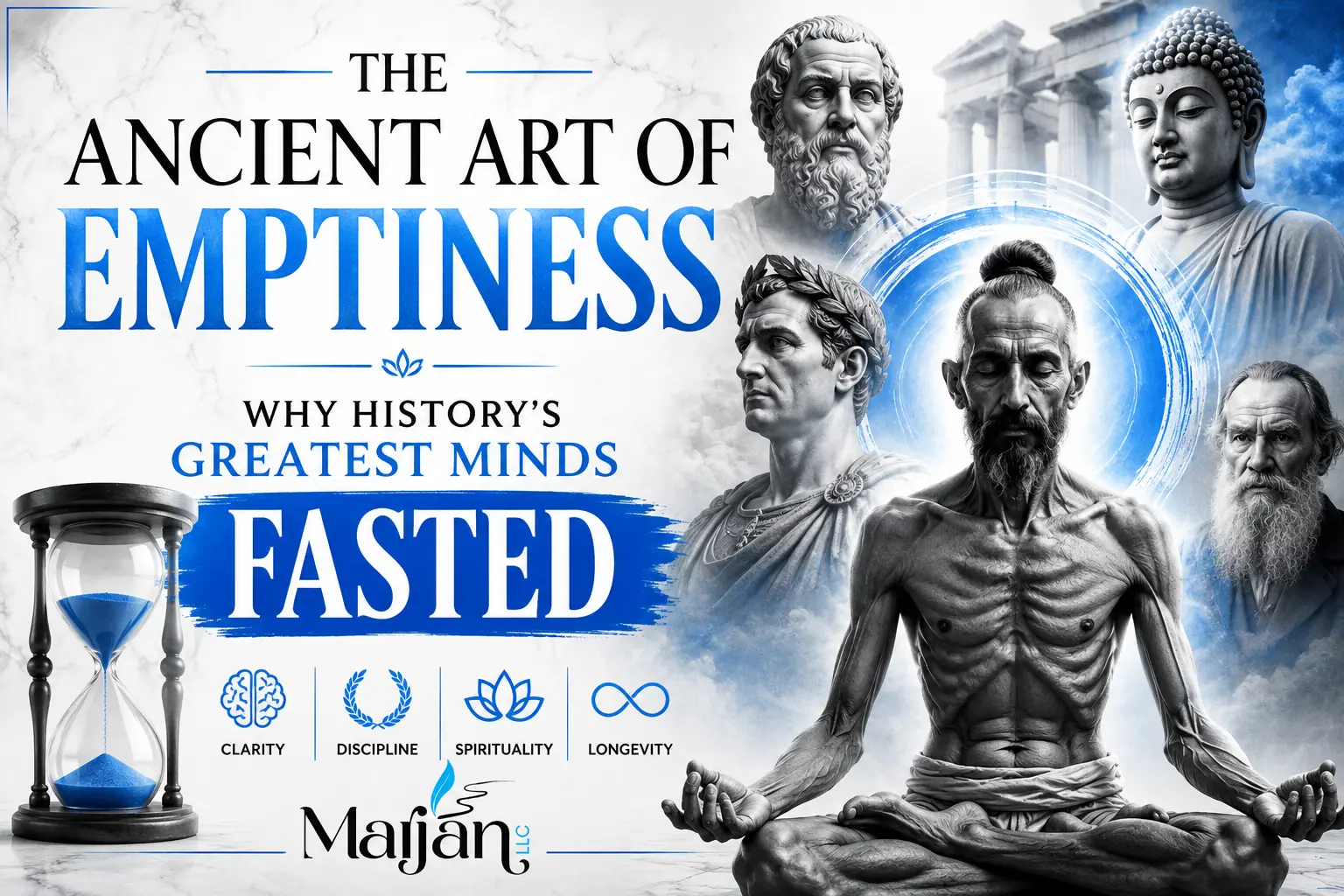
From prophets to tech moguls, skipping meals may be history’s ultimate power move.
Introduction: The Hunger Behind Every Great Idea
In a world drowning in push notifications, ultra-processed convenience food, and 24-hour delivery apps, one ancient discipline keeps surfacing across the most unlikely corners of history: fasting.
Not as a diet. Not as a trend. As a tool.
Across five thousand years of recorded human history, the planet’s most visionary thinkers, spiritual leaders, scientists, and revolutionaries have shared a quiet secret: they emptied themselves to access something greater. Prophets received divine law on mountaintops after 40 days without food. Philosophers mapped the universe on an empty stomach. Silicon Valley founders fast through weekends in pursuit of cognitive clarity. And monks across every tradition still greet the sunrise with an empty belly as a form of reverence.
This is not coincidence. This is a pattern written across civilization.
Whether you’re exploring fasting for health, spiritual discipline, mental performance, or natural healing, understanding why the greatest minds embraced this ancient practice may be the most important thing you read this year.
The Primal Origins of Fasting
Fasting wasn’t invented. It was discovered the hard way.
Our prehistoric ancestors fasted not by choice, but by necessity. When the hunt failed, the stomach emptied. But over generations of observing this pattern, something unexpected was noticed: the days after fasting often brought heightened alertness, sharpened instinct, and a kind of mental electricity that well-fed days rarely produced.
What began as accidental survival became intentional ritual. Fasting was encoded into vision quests, grief ceremonies, rites of passage, and spiritual elevation practices across virtually every indigenous and ancient culture on earth. The body’s response to food scarcity, which included a cascade of hormonal, neurological, and cellular changes, was read by early cultures as a doorway. A thinning of the veil between the ordinary and the extraordinary.
Modern science now confirms what ancient cultures intuited: fasting activates autophagy (cellular self-cleaning), boosts brain-derived neurotrophic factor (BDNF), regulates insulin sensitivity, reduces systemic inflammation, and triggers a hormonal reset that optimizes both physical and cognitive performance.
The spiritual scalpel turned out to have a very sharp biochemical edge.
The Stoics and Their Stomachs
Ancient philosophers weren’t just fans of thinking. They were fans of thinking on an empty stomach.
Socrates, Plato, and Epictetus practiced fasting not as a religious obligation but as a philosophical discipline. For the Stoics, the ability to endure physical discomfort, including hunger, was inseparable from the ability to think clearly and live virtuously. A man who was enslaved to his appetite, they argued, could never truly be free in his mind.
Plato reportedly fasted regularly and believed it enhanced the mind’s access to pure reason. Socrates taught that the body’s demands were the greatest obstacle to philosophical clarity. Epictetus, who had been an actual slave before becoming one of antiquity’s most influential thinkers, framed fasting as a rehearsal for freedom.
Their approach to mental clarity through fasting wasn’t about deprivation for its own sake. It was about demonstrating, daily, that the thinking mind could remain sovereign over physical cravings. That kind of self-mastery, practiced consistently, built a different kind of intelligence: calm, disciplined, and resistant to panic, flattery, and excess.
Moses: 40 Days, No Snacks, and the Ten Commandments
Moses didn’t just fast. He annihilated the concept of brunch.
The biblical account describes Moses ascending Mount Sinai for 40 days without food or water, which falls well outside the range of ordinary human survival. What he returned with, the Ten Commandments, became the foundational moral and legal architecture of three of the world’s major religions and, by extension, Western civilization itself.
When he descended to find the Israelites worshipping a golden calf, he smashed the tablets in fury, then climbed back up and fasted another 40 days, this time interceding for the people’s forgiveness. That’s 80 days of what you might call supernatural fasting, emerging with laws that still govern courts, constitutions, and consciences millennia later.
The prophet Elijah mirrored this. Jesus, in the Judean wilderness, fasted 40 days before beginning his public ministry, enduring spiritual trials that would define the foundational theology of Christianity. Biblical fasting in these accounts isn’t about weight loss. It’s about the radical clearing of self that precedes receiving something too large for the ordinary mind to hold.
Buddha and the Middle Way
In one of history’s most instructive fasting experiments, Siddhartha Gautama pushed physical austerity to its absolute limit.
Convinced that extreme self-denial was the path to enlightenment, the man who would become the Buddha ate almost nothing for years, reducing himself, by classical accounts, to a skeletal silhouette that could hardly sit upright. He was, by any clinical measure, starving.
Then a young woman named Sujata offered him a bowl of rice milk. He accepted. And in that moment of receiving nourishment, something shifted. The insight arrived not in continued starvation but in the recognition that neither indulgence nor self-destruction leads to wisdom.
The Middle Way was born: a path of intentional, balanced living between the extremes of excess and deprivation. Fasting, the Buddha taught, is powerful. Pathological starvation is not enlightenment. It’s just starvation.
Buddhist monks across Theravada, Mahayana, and Zen traditions still practice intermittent fasting as a core discipline, often eating only before noon as an expression of non-attachment and mindful living. The discipline, applied wisely, remains one of the oldest tools for cultivating the mind-body connection in human history.
Pythagoras: Fasting, Math, and Cosmic Harmony
Most people know Pythagoras from a geometry theorem they memorized and immediately forgot. His actual life was considerably more unusual.
Part mathematician, part mystic, part community founder, Pythagoras ran what amounted to a philosophical commune in ancient Croton where students were required to fast before admission. His reasoning was precise: the digestive system, when active, draws energy and attention downward. Fasting redirected that energy upward, toward higher cognition, intuition, and what he called attunement to the numerical harmonies underlying all of reality.
He practiced silence alongside fasting, believing that the combination created an internal stillness in which cosmic truths could be perceived rather than merely reasoned. He was a vegetarian, a number mystic, and an early advocate of what modern science now calls the gut-brain axis, the profound bidirectional connection between digestive health and cognitive function.
You don’t get a theorem named after you by accident. The clarity he sought through natural healing practices and fasting may have been the same clarity that led to his mathematical insights.
Steve Jobs and the iFast Philosophy
Steve Jobs was not a conventional tech founder. He was a Zen Buddhist, a calligraphy student, a fruitarian, and an extended faster who believed that emptying the body was inseparable from emptying the mind of assumption.
His extreme dietary practices, which included extended fruit-only periods, prolonged fasts, and what colleagues described as alarming nutritional minimalism, were not the quirks of an eccentric genius. They were expressions of a deeply held belief that sensory and digestive clarity produced creative and spiritual clarity.
Jobs told his biographer Walter Isaacson that his early experiences with fasting and meditation gave him the ability to focus and tune out noise, which became central to Apple’s design philosophy. The products that changed the world, the Mac, the iPod, the iPhone, emerged from a mind that practiced, daily, the art of subtraction.
“The people who are crazy enough to think they can change the world are the ones who do.” Jobs lived that philosophy with his fork as much as with his code.
Thomas Edison: Fasting and Filaments
Thomas Edison held 1,093 patents, famously battled sleep, and treated minimal eating as a form of mental discipline.
He was known for irregular, sparse meals and for viewing the body’s digestive demands as an interruption to creative work. “Sleep is a criminal waste of time,” he reportedly said, and his attitude toward eating carried a similar flavor. Feed the brain, not the body’s comfort.
Whether or not Edison followed a structured fasting protocol, his approach to boosting energy through nutritional minimalism aligned with what modern intermittent fasting research now confirms: reduced caloric load during working hours enhances alertness, reduces cognitive sluggishness, and keeps the prefrontal cortex performing at its peak.
Edison invented the phonograph, helped develop modern electrical infrastructure, and died in 1931 with his last breath reportedly captured in a test tube by his friend Henry Ford as a final tribute. The man who invented sound recording probably understood, intuitively, that silence and emptiness create the conditions for something new.
Nikola Tesla and the Electric Mind
Nikola Tesla was, by any measure, one of the most extraordinarily wired minds in the history of science. He also fasted with deliberate intention.
Tesla used fasting to sharpen focus during periods of intense invention and to manage what he described as the overwhelming sensitivity of his nervous system. He was highly attuned to sensory input, including light, sound, and electromagnetic fields, and found that fasting reduced the neural noise that made sustained concentration difficult.
His approach anticipated what researchers now understand about the connection between gut microbiome health, neuroinflammation, and cognitive performance. A quieted digestive system, it turns out, is also a quieted nervous system. Mark Twain, another unlikely fasting advocate, famously claimed that fasting had cured more of his ailments than medicine, a sentiment that placed him squarely in the company of the alternative medicine pioneers of his era.
Jack Dorsey, founder of Twitter and Square, has continued this tradition into the digital age, famously fasting through weekends and crediting the practice with sharpening his decision-making and expanding his creative perception.
Hippocrates to Biohackers: Fasting as Medicine
Hippocrates, the Father of Medicine, prescribed fasting not as a spiritual exercise but as a clinical intervention. “Instead of using medicine,” he wrote, “fast for a day.”
His clinical intuition has proven remarkably accurate. Dr. Otto Buchinger of the Buchinger Wilhelmi Clinic in Germany supervised over 200,000 medically monitored fasts during the 20th century, documenting therapeutic benefits across a range of chronic conditions. His clinical work helped legitimize scientific fasting as a medical modality in Europe decades before it reached mainstream awareness in the United States.
The cellular mechanism that explains many of these benefits is autophagy, a process in which the body systematically breaks down and recycles damaged cellular components. In 2016, Japanese cell biologist Yoshinori Ohsumi was awarded the Nobel Prize in Physiology or Medicine for his foundational work on autophagy, which is reliably triggered by fasting.
Dr. Valter Longo of the USC Longevity Institute has since developed fasting-mimicking diets clinically shown to support longevity, metabolic regeneration, and immune system renewal. Benjamin Franklin may have been centuries ahead of the curve when he wrote: “To lengthen thy life, lessen thy meals.”
The biohacking movement has brought these principles to a new generation. Silicon Valley executives, elite athletes, and longevity researchers now treat intermittent fasting and extended fasts as foundational to performance optimization. The ancient prescription has acquired a new vocabulary, but the underlying biology has been unchanged for ten thousand years.
Fasting as Revolution: Gandhi, Mandela, and Chávez
Not all fasting is inward. Some of history’s most powerful fasts were directed outward, at systems of oppression, injustice, and violence.
Mahatma Gandhi called fasting “the sincerest form of prayer.” He fasted publicly and deliberately throughout India’s independence movement, using his own body as a moral instrument. His fasts were not theatrical: they were strategic acts of nonviolent force that mobilized millions, shamed colonial administrators, and altered the geopolitical trajectory of an entire subcontinent.
César Chávez, the American labor leader and civil rights activist, undertook multiple public fasts in the 1960s and 1970s to demand justice for migrant farmworkers in California. His longest fast lasted 36 days. Nelson Mandela, imprisoned on Robben Island, fasted as an act of protest against the apartheid regime, transforming his own suffering into political leverage.
These weren’t hunger pangs. They were declarations. Prayer and fasting as a form of moral resistance carry a weight that no argument, legal brief, or speech can fully replicate. It says: I am willing to suffer in plain sight rather than accept this injustice. It is, historically, among the most persuasive statements a human being can make.
What Science Now Confirms
Modern research has validated, with remarkable precision, what ancient practitioners reported through experience.
Fasting triggers measurable biological benefits, including:
- Autophagy activation: The body’s cellular recycling system clears damaged proteins and dysfunctional organelles, reducing cancer risk and slowing cellular aging.
- BDNF increase: Brain-derived neurotrophic factor, essentially fertilizer for neurons, increases during fasting, enhancing memory, learning, and neuroplasticity.
- Insulin sensitivity improvement: Even short-term fasting dramatically improves the body’s response to insulin, reducing risk factors associated with type 2 diabetes and metabolic syndrome.
- Inflammation reduction: Fasting lowers circulating inflammatory markers, including interleukin-6 and TNF-alpha, thereby reducing inflammation and contributing to chronic disease prevention.
- Gut microbiome reset: Extended fasting provides the intestinal lining with recovery time and enables a beneficial rebalancing of the gut microbial ecosystem.
- Hormonal optimization: Growth hormone surges during fasting, supporting lean muscle retention, fat metabolism, and cellular repair.
The detox guide implications are profound. Far from being a fringe health claim, fasting detoxification is now supported by peer-reviewed literature, Nobel Prize-winning cellular biology research, and clinical trial data from leading longevity institutions worldwide.
Frequently Asked Questions
What is fasting for health, and how does it work biologically? Fasting for health refers to deliberately abstaining from food for defined periods to trigger beneficial biological processes. These include autophagy (cellular self-repair), hormonal rebalancing, reduced inflammation, and neurological optimization via increased BDNF. Both ancient healers and modern scientists confirm that the body uses periods of food deprivation as opportunities to repair, reset, and regenerate.
Did historical figures like Moses and Jesus actually fast for 40 days? Biblical and historical accounts describe Moses, Elijah, and Jesus each fasting for 40 days. Whether interpreted literally or as symbolic narratives of profound spiritual transformation, these accounts have shaped the practice of biblical fasting across Judaism, Christianity, and Islam for thousands of years. Medically supervised extended fasts do exist, though rarely of that duration and only under clinical care.
What is the difference between intermittent fasting and extended fasting? Intermittent fasting involves cycling between eating and fasting windows within a 24-hour or weekly period, such as the 16:8 protocol (16 hours fasting, 8 hours eating). Extended fasting refers to fasts lasting 24 hours or more, up to several days, typically for more intensive detoxification, cellular regeneration, and therapeutic purposes. Both forms carry documented health benefits.
Can fasting improve mental clarity and cognitive performance? Yes. Research consistently shows that fasting increases BDNF (brain-derived neurotrophic factor), reduces neuroinflammation, and improves mitochondrial efficiency in brain cells. Many historical figures, from Plato to Nikola Tesla to Steve Jobs, reported heightened creative and intellectual clarity during fasting periods. Modern practitioners, including Jack Dorsey, echo these observations.
What is autolysis or autophagy in the context of fasting? Autophagy is the cellular process by which the body identifies and breaks down damaged proteins, dysfunctional organelles, and cellular debris, effectively cleaning house at the microscopic level. It is reliably triggered by fasting and was the subject of the 2016 Nobel Prize in Physiology or Medicine awarded to Yoshinori Ohsumi. Autophagy is considered a key mechanism behind fasting’s anti-aging, cancer-preventive, and metabolic benefits.
Is fasting safe for everyone? Fasting is not universally appropriate. People with diabetes, eating disorders, pregnancy, certain cardiovascular conditions, or those on specific medications should consult a qualified healthcare provider before undertaking any fasting protocol. Short-term intermittent fasting is generally well-tolerated by healthy adults, whereas extended fasting should ideally be approached with medical supervision.
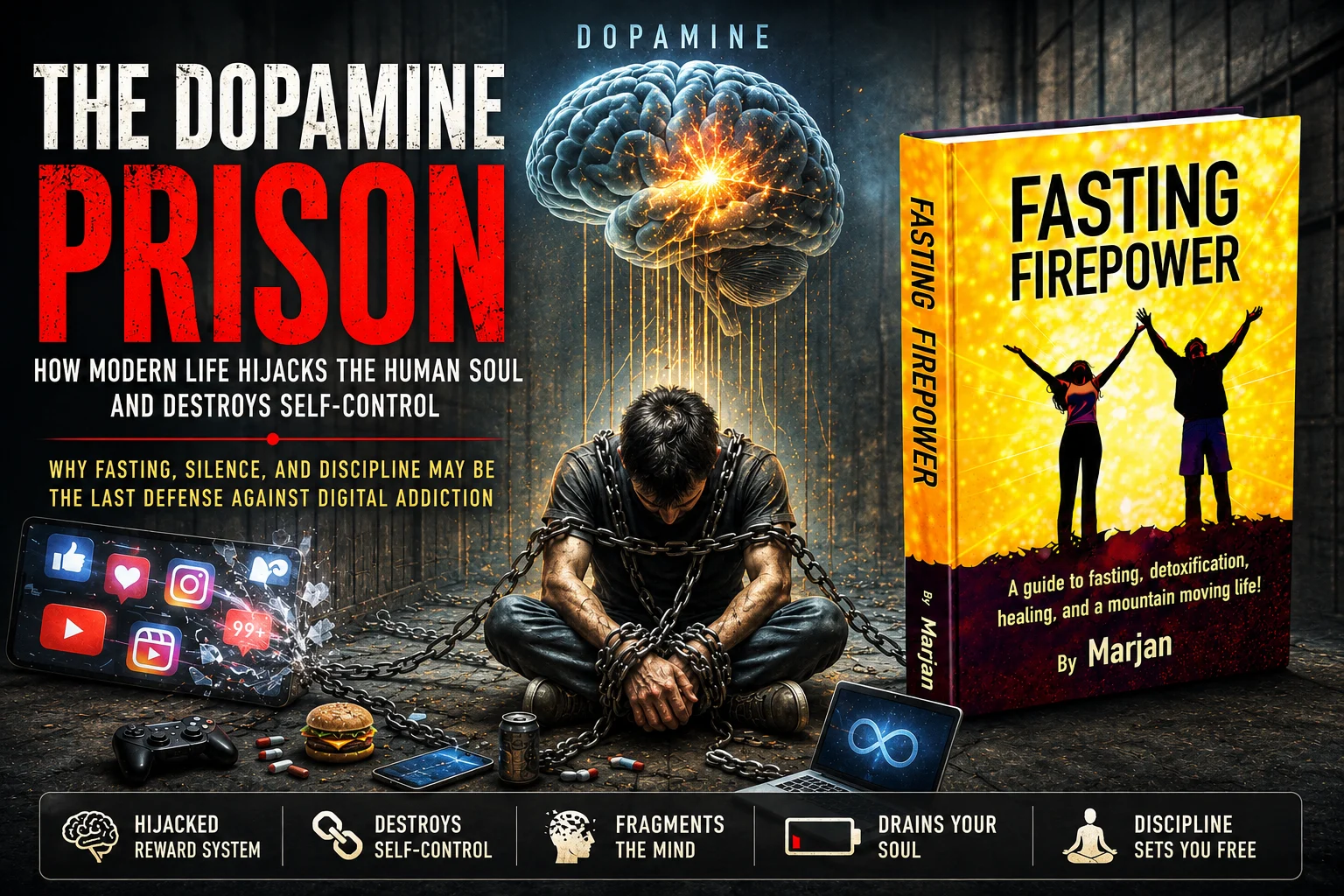
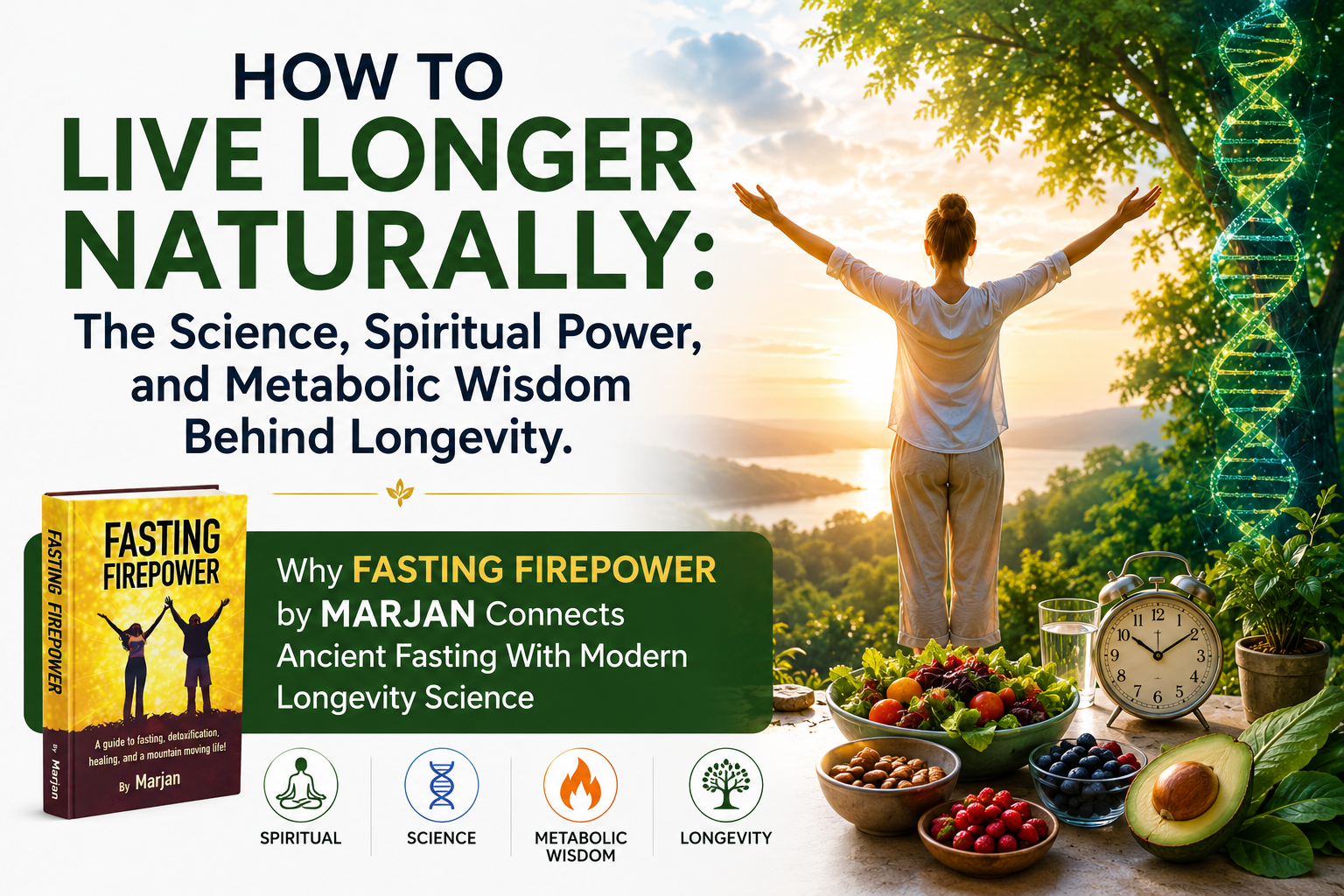
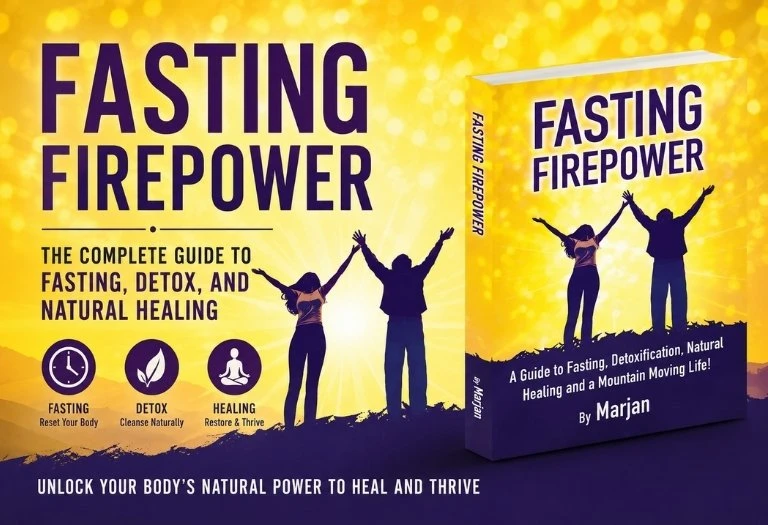
Where can I learn more about fasting from a comprehensive, research-backed perspective? Fasting Firepower by Marjan is one of the most thorough resources available, combining ancient wisdom, cutting-edge science, and five decades of personal fasting experience into an accessible, practical guide. Visit marjanbooks.com or watch free content on the Marjan Books YouTube channel.
Conclusion: Empty Yourself to Access Everything
Across every era, culture, tradition, and discipline, the pattern is identical. The greatest minds, from prophets who carved civilization’s moral code into stone to engineers who rewired the modern world, have consistently turned to the same ancient technology when they needed access to something beyond ordinary cognition.
They fasted.
Not to punish themselves. Not to follow a trend. But because they understood, in ways both intuitive and rigorously observed, that the human mind at its most powerful operates from a place of disciplined emptiness rather than comfortable fullness.
From Moses’s 40 days on the mountain to Jack Dorsey’s weekend fasts in San Francisco, the thread is unbroken. The discipline is available to everyone. The results, if history is any evidence, can be extraordinary.
If you’re ready to explore fasting’s full potential, from its ancient wisdom roots to its cutting-edge scientific applications, Fasting Firepower by Marjan brings together 50 years of personal experience, biblical insight, clinical research, and practical guidance into one of the most comprehensive fasting resources available.
Readers at the Online Book Club have given it five stars for its clarity, depth, and life-changing practical value. Martha Lopez, Beth Condit, Mavis Opara, and Jamal Ibrahim are among the readers whose lives have been measurably impacted by its content.
Watch Marjan’s insights on fasting on the Marjan Books YouTube channel and visit marjanbooks.com to learn more and get your copy.
No one should lead a debilitated life for lack of this vital information.